
Pediatric Eczema Treatment: Where Dupilumab and Topical JAK Inhibitors Fit
Two newer drug classes are reshaping the step-up ladder for atopic dermatitis in children — but they occupy different rungs. Here is what the pediatric trial evidence supports for each.
One-Minute Takeaway
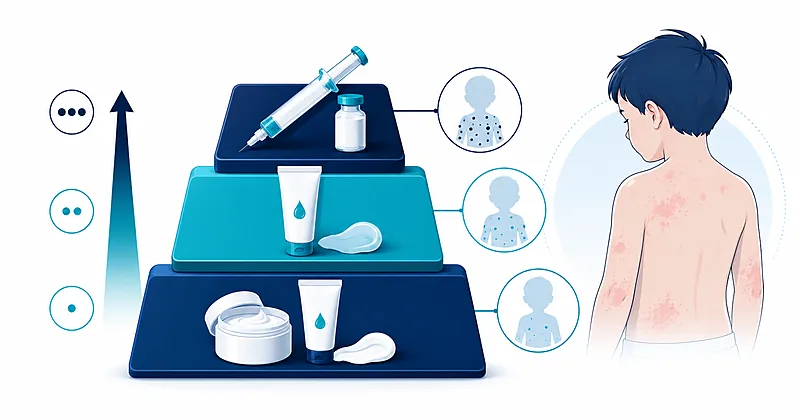
- Pediatric eczema treatment has expanded from topical steroids into a three-tier framework, and the strongest evidence — multiple phase 3 randomized trials — places dupilumab and topical JAK inhibitors at different rungs, not in direct competition.
- Dupilumab, an injectable biologic, is FDA-approved from 6 months of age for moderate-to-severe disease; EASI-75 response reached 53% in children under 6 years and roughly 70% in ages 6–11 years, versus placebo.
- Topical ruxolitinib, a JAK inhibitor cream, is FDA-approved from age 2 for mild-to-moderate disease; 56% of children achieved investigator-rated treatment success at 8 weeks versus 11% with vehicle.
- The classes fill different niches: systemic control for widespread moderate-to-severe disease, versus a non-steroidal topical for limited mild-to-moderate disease.
- Topical JAK inhibitors carry a class boxed warning; dupilumab requires no routine laboratory monitoring.
Why Pediatric Eczema Treatment Matters
Atopic dermatitis is among the most common chronic conditions of childhood. In United States survey data, the prevalence in children rose from about 7% in 2000 to roughly 13% by the 2010s and has since held near that level. Most cases begin in infancy or the toddler years.
Severity is skewed toward the milder end: most affected children have mild disease, with a smaller share carrying moderate or severe involvement. That distribution matters, because it maps directly onto which therapies are appropriate.
The burden is not cosmetic. Persistent itch disrupts sleep, school performance, and mood, and atopic dermatitis frequently sits at the start of the atopic march toward food allergy, asthma, and allergic rhinitis. For families, control of a visible, itchy condition carries real quality-of-life weight.
These stakes explain why pediatric eczema treatment has drawn sustained drug development. Within a few years, regulators cleared a biologic down to infancy and expanded a topical JAK inhibitor to age 2, compressing years of change into a short window clinicians must now navigate.
Until recently, the options above topical steroids were sparse. The arrival of a targeted biologic and non-steroidal topical JAK inhibitors changed that — which is exactly why clear positioning of each within pediatric eczema treatment now matters.
The Clinical Problem in Pediatric Eczema Treatment
The conventional pediatric eczema treatment ladder is well established. It begins with liberal emollients and trigger avoidance, adds topical corticosteroids (TCS) for flares, and layers in topical calcineurin inhibitors (TCI) for steroid-sparing maintenance, particularly on the face and folds.
Two persistent gaps sit inside that ladder. The first is the child whose disease is widespread and refractory to topicals; historically the next step meant off-label systemic immunosuppressants — cyclosporine, methotrexate, azathioprine — with limited pediatric trial support and meaningful monitoring burden.
The second gap is more mundane but common: caregivers reluctant to apply topical steroids repeatedly, a pattern often described as steroid phobia, alongside legitimate concern about long-term use on delicate pediatric skin. Adherence suffers, and disease smoulders.
Dupilumab and the topical JAK inhibitors address different halves of this problem. One offers systemic control without traditional immunosuppression; the other offers a non-steroidal topical for localized disease. The central question is not which is superior, but where each belongs. This review compares three practical approaches across that landscape.
Available Approaches
Three approaches now structure pediatric eczema treatment: conventional topical therapy as the foundation, dupilumab as the systemic option for moderate-to-severe disease, and topical JAK inhibitors as a non-steroidal topical for mild-to-moderate disease. The comparative evidence below draws only on figures verified against primary sources.
| Trial (agent) | Design | N | Population | Key result | Tier |
|---|---|---|---|---|---|
| LIBERTY AD PRESCHOOL — Paller 2022 (dupilumab) | RCT, double-blind, placebo-controlled, 16 wk, + low-potency TCS | 162 | 6 months to <6 years; moderate-to-severe (IGA 3–4) | EASI-75 53% vs 11% (difference 42%, 95% CI 29–55); IGA 0/1 28% vs 4% (difference 24%, 95% CI 13–34); p<0.0001 | [V] |
| LIBERTY AD PEDS — Paller 2020 (dupilumab) | RCT, double-blind, placebo-controlled, 16 wk, + medium-potency TCS | 367 | 6–11 years; severe (IGA 4) | EASI-75 69.7% (q4w) / 67.2% (q2w) vs 26.8%; IGA 0/1 32.8% / 29.5% vs 11.4% | [V] |
| AD ADOL — Simpson 2020 (dupilumab) | RCT, double-blind, placebo-controlled, 16 wk, monotherapy | 251 | 12–17 years; moderate-to-severe | EASI-75 41.5% (q2w) / 38.1% (q4w) vs 8.2% (q2w difference 33.2%, 95% CI 21.1–45.4); p<0.001 | [V] |
| TRuE-AD3 — Eichenfield 2025 (ruxolitinib cream) | RCT, double-blind, vehicle-controlled, 8 wk | 330 | 2–11 years; mild-to-moderate (IGA 2/3), BSA 3–20% | IGA treatment success 56.5% (1.5%) / 36.6% (0.75%) vs 10.8% vehicle; p<0.0001 / p=0.0001 | [V] |
| TRuE-AD1 / TRuE-AD2 — Papp 2021 (ruxolitinib cream) | Two RCTs, double-blind, vehicle-controlled, 8 wk | 1249 | ≥12 years; mild-to-moderate (IGA 2/3), BSA 3–20% | IGA treatment success 53.8% / 51.3% (1.5%) vs 15.1% / 7.6% vehicle; p<0.0001 | [V] |
| Nakagawa 2021 (delgocitinib ointment) | RCT, double-blind, vehicle-controlled, 4 wk (Japan) | 137 | 2–15 years; mild / moderate / severe | Modified EASI change −39.3% vs +10.9%; p<0.001 | [V] |
A structural caution is built into this table: the dupilumab trials enrolled moderate-to-severe disease, while the ruxolitinib trials enrolled mild-to-moderate disease with limited body-surface involvement. The response rates therefore describe different populations and cannot be read as a head-to-head ranking.
Conventional topical therapy (the foundation)
Emollients, topical corticosteroids, and topical calcineurin inhibitors remain first-line for most children and are the recommended base of care in current guidelines. They control the majority of disease, which is mild. The newer agents are add-ons or alternatives for defined situations, not replacements for this foundation.
Any discussion of pediatric eczema treatment that skips this base misreads the epidemiology. Because most childhood disease is mild, most children never need a systemic agent or a topical JAK inhibitor at all — a point worth stating plainly before the newer classes take the spotlight.
Dupilumab (the systemic biologic)
Dupilumab is a monoclonal antibody blocking interleukin-4 and interleukin-13 signalling, central drivers of type 2 inflammation. It is given by subcutaneous injection and is FDA-approved for moderate-to-severe atopic dermatitis from 6 months of age, used with or without topical corticosteroids.
Across three age-stratified phase 3 trials, dupilumab led to consistent, clinically meaningful improvement versus placebo. In the youngest cohort (under 6 years), 53% reached EASI-75 versus 11%. In ages 6–11 with severe disease, roughly 70% reached EASI-75 versus 27%. Response in adolescents was of similar magnitude on monotherapy.
The safety signal has been reassuringly consistent: the most notable adverse event is conjunctivitis (for example, about 5% versus none in the youngest trial), and no routine laboratory monitoring is required.
Topical JAK inhibitors (the non-steroidal topical)
Topical JAK inhibitors block Janus kinase signalling locally in the skin. Ruxolitinib cream, a JAK1/JAK2 inhibitor, is the option available in the United States; following a 2025 expansion it is FDA-approved for mild-to-moderate disease from age 2, for short-term and non-continuous use on up to 20% of body surface area.
In the pediatric TRuE-AD3 trial, 56.5% of children applying 1.5% ruxolitinib achieved investigator-rated treatment success at 8 weeks versus 10.8% with vehicle, mirroring results in the adolescent and adult TRuE-AD1/TRuE-AD2 studies. Delgocitinib ointment, a pan-JAK inhibitor, is approved for pediatric atopic dermatitis in Japan but not by the FDA.
The trade-off is the safety framing. Ruxolitinib cream carries a boxed warning applied across the JAK inhibitor class. It covers serious infections, malignancy, major adverse cardiovascular events, thrombosis, and mortality — events not seen at meaningful rates in the topical AD trials themselves.
Comparative Analysis
No trial has compared dupilumab against a topical JAK inhibitor in children. Positioning therefore rests on four practical axes rather than a direct efficacy contest: disease severity and extent, patient age, route and monitoring, and the safety profile.
Severity and extent
This is the dominant divider. Dupilumab is studied and licensed for moderate-to-severe disease, typically widespread. Ruxolitinib is studied and licensed for mild-to-moderate disease confined to 20% or less of the body surface. Extensive disease falls outside the topical JAK evidence base entirely.
Age coverage
Dupilumab reaches youngest, approved from 6 months, and is the only agent here with randomized evidence in infants. Ruxolitinib cream is approved from age 2. For a child under 2 with significant disease, dupilumab is the option with supporting trial data; topical JAK inhibitors are not indicated.
Route and monitoring
Dupilumab is injected, which some families resist, but requires no routine bloodwork. Ruxolitinib is a cream — attractive for localized disease and needle-averse children — but its labeling restricts it to short-term, non-continuous use on limited surface area, which constrains its role in chronic widespread control.
Safety framing
The class boxed warning on JAK inhibitors is the single most consequential counseling point. It derives from oral JAK inhibitor data in adult populations, not from pediatric topical AD events, and systemic absorption from the cream is low. Clinicians must nonetheless disclose it, and it weighs differently for a brief course on a small area than for prolonged use.
Read together, these axes describe complementary tools. Topical JAK inhibitors extend the non-steroidal topical tier for limited disease; dupilumab occupies the systemic tier for widespread moderate-to-severe disease that has escaped topical control. In an adolescent with moderate, patchy disease, both may be reasonable — the clearest zone of genuine overlap.
The result is a more layered model of pediatric eczema treatment than the older topicals-then-immunosuppressants ladder. Two mechanism-targeted classes now bracket conventional topicals from above and beside, each anchored to a defined severity band rather than competing for the same patient.
Quality and Consistency of the Evidence
The evidence base is strongest for short-term efficacy and thinnest for long-term pediatric safety and for direct comparison. Strength of evidence by domain:
- High — Dupilumab short-term efficacy. Three age-stratified, double-blind, placebo-controlled phase 3 trials show consistent, clinically meaningful benefit from infancy through adolescence, with effect estimates that align across cohorts.
- High — Topical ruxolitinib short-term efficacy. The pediatric TRuE-AD3 trial and the ≥12-year TRuE-AD1/TRuE-AD2 studies are vehicle-controlled and concordant, though the primary endpoint is measured at 8 weeks.
- Moderate — Dupilumab durability and safety. Open-label extension data extend follow-up to 52 weeks with a stable profile, but randomized long-term pediatric data remain limited.
- Moderate — Delgocitinib. Evidence is randomized but comes from a small, single-country (Japan) program without FDA review; generalizability outside that setting is uncertain.
- Low — Long-term topical JAK safety in children. Controlled pediatric follow-up is short, and the class boxed warning rests on extrapolation from oral agents rather than pediatric topical data.
- Very low / absent — Head-to-head comparison. No randomized trial has compared dupilumab with a topical JAK inhibitor in children; all positioning is indirect.
What the Evidence Does Not Show
Several specific questions about pediatric eczema treatment remain unanswered by the current pediatric evidence:
- No direct comparison. There is no randomized head-to-head trial of dupilumab versus a topical JAK inhibitor in children, so relative efficacy within any single severity band is not established.
- No long-term pediatric JAK safety data. Controlled follow-up for topical JAK inhibitors in children is short; multi-year outcomes are not yet defined.
- Extensive disease is untested for topical JAK. Ruxolitinib trials capped body-surface involvement at 20% and treatment at 8 weeks, so efficacy and safety in widespread or continuously treated pediatric disease are unknown.
- Guidelines are adult-anchored. Current systemic-therapy recommendations were developed for adults; pediatric use rests on FDA approvals and the age-specific trials rather than on dedicated pediatric guideline recommendations.
- Disease modification is unproven. Whether either class alters the atopic march or long-term disease trajectory in children has not been demonstrated.
- Access and cost are out of scope. Efficacy trials do not address affordability, insurance coverage, or real-world adherence, which materially shape which option a family can actually use.
Practical Implications
The evidence supports matching the agent to severity, extent, and age rather than choosing a single default. The following reflect what the trial data and current labeling support.
For limited, mild-to-moderate disease, topical therapy remains the base. Where steroids are declined, poorly tolerated, or being spared on the face and folds, a topical JAK inhibitor is a reasonable non-steroidal option from age 2, within its short-term, limited-surface labeling and after boxed-warning counseling.
For widespread moderate-to-severe disease inadequately controlled by topicals, dupilumab is the option with randomized support across the pediatric age range, including infants from 6 months, and without a routine monitoring requirement.
For adolescents with moderate, patchy disease, both classes may be appropriate; the choice turns on distribution, injection versus cream preference, surface area, and how the family weighs the boxed warning against dupilumab’s injection burden.
In each case, shared decision-making — covering route, monitoring, expected time to response, and safety framing — is what turns the evidence into a workable plan.
Framed this way, pediatric eczema treatment is less about ranking drugs and more about routing each child to the tier the evidence supports. The severity label, the child’s age, and the family’s tolerance for injections versus a boxed warning do most of that routing.
Evidence Grade and Bottom Line
- Both dupilumab and topical ruxolitinib have consistent phase 3 randomized evidence for short-term efficacy in children and now anchor pediatric eczema treatment beyond conventional topicals; the benefit over placebo or vehicle is clear and reproducible.
- They are not interchangeable and were not tested against each other. Severity and extent, not a head-to-head result, determine which fits: systemic for widespread moderate-to-severe disease, topical JAK for limited mild-to-moderate disease.
- Dupilumab has the broadest age reach (from 6 months) and no routine monitoring; topical JAK inhibitors add a non-steroidal topical option from age 2 but carry a class boxed warning and surface-area and duration limits.
- The main evidence gaps — no head-to-head trial, limited long-term pediatric JAK safety, and adult-anchored guidelines — mean positioning should be revisited as pediatric data mature.
Article Information and References
- Paller AS, Simpson EL, Siegfried EC, et al. Dupilumab in children aged 6 months to younger than 6 years with uncontrolled atopic dermatitis: a randomised, double-blind, placebo-controlled, phase 3 trial. Lancet. 2022;400(10356):908–919. DOI: https://doi.org/10.1016/S0140-6736(22)01539-2
- Paller AS, Siegfried EC, Thaçi D, et al. Efficacy and safety of dupilumab with concomitant topical corticosteroids in children 6 to 11 years old with severe atopic dermatitis: a randomized, double-blinded, placebo-controlled phase 3 trial. J Am Acad Dermatol. 2020;83(5):1282–1293. DOI: https://doi.org/10.1016/j.jaad.2020.06.054
- Simpson EL, Paller AS, Siegfried EC, et al. Efficacy and safety of dupilumab in adolescents with uncontrolled moderate to severe atopic dermatitis: a phase 3 randomized clinical trial. JAMA Dermatol. 2020;156(1):44–56. DOI: https://doi.org/10.1001/jamadermatol.2019.3336
- Eichenfield LF, Stein Gold LF, Simpson EL, et al. Efficacy and safety of ruxolitinib cream in children aged 2 to 11 years with atopic dermatitis: results from TRuE-AD3, a phase 3, randomized double-blind study. J Am Acad Dermatol. 2025;93(3):689–698. DOI: https://doi.org/10.1016/j.jaad.2025.05.1385
- Papp K, Szepietowski JC, Kircik L, et al. Efficacy and safety of ruxolitinib cream for the treatment of atopic dermatitis: results from 2 phase 3, randomized, double-blind studies. J Am Acad Dermatol. 2021;85(4):863–872. DOI: https://doi.org/10.1016/j.jaad.2021.04.085
- Eichenfield LF, Simpson EL, Papp K, et al. Efficacy, safety, and long-term disease control of ruxolitinib cream among adolescents with atopic dermatitis: pooled results from two randomized phase 3 studies. Am J Clin Dermatol. 2024;25(4):669–683. DOI: https://doi.org/10.1007/s40257-024-00855-2
- Papp K, Szepietowski JC, Kircik L, et al. Long-term safety and disease control with ruxolitinib cream in atopic dermatitis: results from two phase 3 studies. J Am Acad Dermatol. 2023;88(5):1008–1016. DOI: https://doi.org/10.1016/j.jaad.2022.09.060
- Nakagawa H, Nemoto O, Igarashi A, et al. Delgocitinib ointment in pediatric patients with atopic dermatitis: a phase 3, randomized, double-blind, vehicle-controlled study and a subsequent open-label, long-term study. J Am Acad Dermatol. 2021;85(4):854–862. DOI: https://doi.org/10.1016/j.jaad.2021.06.014
- Davis DMR, Drucker AM, Alikhan A, et al. Guidelines of care for the management of atopic dermatitis in adults with phototherapy and systemic therapies. J Am Acad Dermatol. 2024;90(2):e43–e56. DOI: https://doi.org/10.1016/j.jaad.2023.08.102
- Davis DMR, Drucker AM, Alikhan A, et al. Focused update: guidelines of care for the management of atopic dermatitis in adults. J Am Acad Dermatol. 2025 (Epub ahead of print). DOI: https://doi.org/10.1016/j.jaad.2025.05.1386
- Hou A, Silverberg JI. Secular trends of atopic dermatitis and its comorbidities in United States children between 1997 and 2018. Arch Dermatol Res. 2022;314(3):267–274. DOI: https://doi.org/10.1007/s00403-021-02219-w