
Pediatric Heart Murmurs: 4 Critical Approaches Compared
When the bedside exam should settle it, when the cardiologist should, and when the echocardiogram adds nothing at all.
One-Minute Takeaway
- Most pediatric heart murmurs are innocent, but age resets the base rate: across 1,928 newborns with asymptomatic, non-syndromic murmurs, 37.3% had congenital heart disease on echocardiography, and 2.5% had severe disease needing immediate intervention.
- In children aged 2 to 18, a murmur that completely disappears on standing carried a positive predictive value of 98% for excluding pathology, with specificity 93% and sensitivity 60%.
- Against echocardiography, pediatric cardiologists’ neonatal examination alone reached 80.5% sensitivity (95% CI 73.2–87.8) and 90.9% specificity (95% CI 84.9–96.9).
- Of 85 echocardiograms rated Rarely Appropriate among 1,701 children referred for a murmur, none showed an abnormality.
- Highest tier available: a systematic review of observational studies plus prospective diagnostic-accuracy cohorts. No randomised trial compares referral strategies.
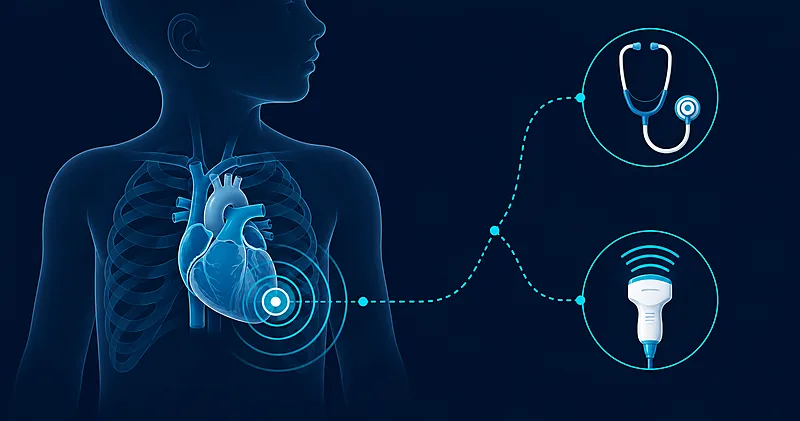
Why Pediatric Heart Murmurs Matter
Pediatric heart murmurs send more children to cardiology than any other finding. One large pediatric cardiology practice logged 1,701 consecutive murmur referrals in a six-month window. Across nearly 8,000 first-time outpatient echocardiograms, murmur was the single commonest indication.
Both possible errors are measurable, and neither is rare. When 357 children were sent for a newly noticed murmur, the cardiologist heard nothing at all in 34 of them. Among newborns with an asymptomatic, non-syndromic murmur, 2.5% carried severe disease requiring catheterisation or surgery.
The Clinical Problem in Pediatric Heart Murmurs
The difficulty with pediatric heart murmurs is that pre-test probability moves by more than an order of magnitude across childhood, while the physical sign barely changes. The same soft systolic murmur means something different at three days and at eight years.
Pre-Test Probability by Age
Every figure below was confirmed against its primary source. The populations differ, so these are not interchangeable estimates — but the gradient across them is the single most useful thing in this literature.
| Age band and setting | n | Verified risk | Source |
|---|---|---|---|
| Newborn, asymptomatic, non-syndromic murmur | 1,928 | 37.3% congenital heart disease; over half moderate; 2.5% severe, needing immediate intervention | Yoon 2020 systematic review |
| Neonate referred to cardiology for a murmur (median 12 days) | 201 | 56% congenital heart disease (113 of 201) | Mackie 2009 prospective cohort |
| Infant/toddler 1 month–4 years, asymptomatic murmur, sent for echo | 462 | 1% severe pathology; none severe among studies ordered after 6 months of age | Kwiatkowski 2012 cohort |
| Child 2–18 referred to cardiology for a murmur | 194 | 15% pathologic murmur on echo (30 of 194) | Lefort 2017 prospective cohort |
| Asymptomatic child 2–18 referred for a murmur | 473 | 7.0% cardiac pathology; 5.9% for newly noticed murmurs, 10.3% for known ones | Gupta 2017 cohort |
The one variable that reliably moves the decision
Across every verified cohort here, age at presentation did more work than any single auscultatory feature. A murmur in the newborn nursery and a murmur at the five-year well-child visit are not the same clinical object, and the evidence supports treating them differently.
Who Is Listening Changes the Answer
Among 169 asymptomatic neonates with murmurs, of whom 55 (32.6%) had abnormal cardiac anatomy, pediatric trainees’ auscultation was associated with lower discrimination than neonatologists’. The areas under the curve were 0.855 and 0.919 respectively. That is a diagnostic-accuracy comparison rather than a causal one.
Even specialist ears have a ceiling. In the Mackie 2009 neonatal cohort, cardiologists’ clinical assessment reached 80.5% sensitivity against echocardiography. Roughly one neonate in five with disease was called likely innocent at the bedside.
The Two Errors Are Not Equal
The two ways of getting pediatric heart murmurs wrong carry very different costs. Missing a critical lesion is rare and catastrophic. An unnecessary referral is common, survivable, and cumulatively expensive in clinic slots, sedation, and parental anxiety.
Any defensible strategy prices that asymmetry rather than optimising raw accuracy.
Available Approaches
Four strategies compete for the referral decision in pediatric heart murmurs, and the evidence base for each differs sharply in both size and design. The table below draws only on studies whose sample size, design, and headline result were confirmed against a retrieved primary source with a resolving DOI.
| Study | Design | N | Population | Question addressed | Key result |
|---|---|---|---|---|---|
| Yoon 2020 | Systematic review (6 cohort, 4 cross-sectional, 2 case reports) | 1,928 | Newborns with asymptomatic, non-syndromic murmur | Yield of echocardiography | 719 (37.3%) had congenital heart disease; VSD commonest; over half moderate; 2.5% severe, needing immediate intervention. Murmur incidence 0.6–8.6% |
| Mackie 2009 | Prospective consecutive cohort, echo reference | 201 | Neonates referred for murmur, median age 12 days | Accuracy of cardiologist auscultation | CHD in 113/201 (56%). Exam alone: sensitivity 80.5% (95% CI 73.2–87.8), specificity 90.9% (95% CI 84.9–96.9), PPV 91.9% (95% CI 86.6–97.3) |
| Lefort 2017 | Prospective consecutive cohort, 2 centres, echo in all | 194 | Children aged 2–18 referred for murmur | Value of murmur disappearance on standing | 30 (15%) pathologic. Disappearance on standing: PPV 98%, specificity 93%, sensitivity 60%. Of 100 whose murmur vanished, 2 were pathologic and 1 needed further evaluation |
| Danford 2002 | Prospective, blinded, echo as reference standard | 903 | Outpatients under 21 with murmur, no prior echo or consult | Echo yield when the murmur sounds innocent but doubt persists | Disease correlated with younger age and examiner suspicion; 16 of 187 cases with no specific pathology suspected had disease, and 6 of those 16 went on to catheter or surgical intervention |
| Rose-Felker 2016 | Retrospective consecutive cohort, AUC-rated | 1,701 | Patients aged 18 or under referred for murmur evaluation | Appropriateness and yield of echo for murmur | 526 (30.9%) had echo: 441 Appropriate, 85 Rarely Appropriate. Abnormal findings in 130/441 Appropriate and 0/85 Rarely Appropriate. Infants under 3 months: highest yield |
| Gupta 2017 | Retrospective cohort | 473 | Asymptomatic children aged 2–18 referred for murmur | “New” versus “known” murmur as a referral trigger | 33 (7.0%) had cardiac pathology: 21/357 (5.9%) of new-murmur referrals versus 12/116 (10.3%) of known-murmur referrals. 34/357 (9.5%) of new-murmur referrals had no murmur at cardiology exam |
| Kwiatkowski 2012 | Retrospective cohort | 462 | Children aged 1 month–4 years, asymptomatic murmur, sedated echo | Echo yield by age and by referring specialty | 6 (1%) had severe pathology; none among studies ordered after 6 months of age. Yield fell as age rose; abnormalities were more frequent among cardiologist-ordered studies |
| Lang 2017 | Retrospective cohort with cost analysis | 7,854 | First-time outpatient pediatric echos, median age 7.2 years | Diagnostic yield by indication and ordering specialty | 1,179 (15%) abnormal. Cardiology-ordered yield higher by 35% across indications and by 100% for murmur versus primary care. Modelled 19.6% cost reduction for murmur with consultation first |
| Yi 2002 | Decision-analytic cost-effectiveness model | Modelled cohort (no enrolled patients) | Children aged 1 month–18 years with asymptomatic murmur | Six evaluation strategies after the pediatrician’s exam | Adding chest radiograph and ECG, or selectively referring straight to echo, raised cost with little gain in accuracy. Three strategies were not cost-effective. Results sensitive to local referral and echo prices |
| Shekhar 2022 | CNN development and internal test; cardiologist label reference, echo for pathologic | 1,473 | Pediatric patients aged 2–17, electronic stethoscope recordings | Automated identification of Still’s murmur | Sensitivity 90.0%, specificity 98.3% at the default threshold; AUROC 0.943. Best performance from recordings at the lower left sternal border alone |
| Hsieh 2025 | Residual-recurrent neural network development and validation | 500 | Pediatric participants, real-world clinic recordings | Automated murmur detection | Participant level: accuracy 90.0%, sensitivity 88.8%, specificity 91.2%. Recording level: accuracy 88.5%, sensitivity 85.5%, specificity 90.7% |
Structured Auscultation at the Bedside
The most useful verified bedside manoeuvre for pediatric heart murmurs in older children is also the simplest. The Lefort 2017 cohort auscultated 194 consecutive children aged 2 to 18 supine, then standing, and echocardiographed every one of them.
Complete disappearance of the murmur on standing excluded pathology with a positive predictive value of 98%. Specificity was 93% but sensitivity only 60%. The manoeuvre rules out; it does not rule in.
Two boundaries limit it. The cohort was aged 2 and over, so nothing transfers to infants. The examiners were pediatric cardiologists, so performance in general pediatric hands has not been established.
Beyond the murmur itself, a narrative review of murmur evaluation lists the findings that raise the odds of a pathological origin [S]:
- Thrills, heaves or lifts, or a laterally displaced apex
- Abnormal heart sounds, gallop rhythms, or clicks
- Abnormal peripheral pulses
- Hepatomegaly
The same review treats three things as referral triggers in their own right [S]:
- Historical features suggesting underlying cardiac disease
- Any abnormal physical examination finding
- An unresolved distinction between innocent and pathological
That list comes from a narrative review rather than a primary cohort. It carries no effect sizes here, for the reason set out under gaps.
Adjunctive ECG and Chest Radiography
The instinct to order a tracing and a film before deciding has not survived the evidence. The Yi 2002 decision analysis modelled six strategies following the pediatrician’s examination in children aged 1 month to 18 years with an asymptomatic murmur.
Adding chest radiography and electrocardiography to the examination increased cost with little gain in accuracy. So did selectively referring straight to echocardiography. Three of the six strategies were not cost-effective on the model’s own terms.
The model priced the trade-off explicitly, in 2002 United States dollars. Referring only suspected pathologic murmurs to a cardiologist detected 82% of pathologic murmurs at $72 per patient evaluated.
Referring every child with a murmur to a cardiologist detected 95%, at $38,000 per additional case found. Sending every child for echocardiography detected 100%, at $158,000 per additional case beyond that. The authors framed the choice between those two as a question of what society should pay per diagnosis, not as a clinical error.
The neonatal accuracy literature built the same question into its design: cardiologists recorded a judgement, then recorded it again after seeing an electrocardiogram. Published summaries of that cohort report no improvement in sensitivity or specificity from the added tracing [S] — a secondary rather than primary confirmation.
The combined workup does perform in expert hands, which is the honest counter-argument. The Geva 1988 cohort of 100 referred children called 50 murmurs innocent after examination, ECG, and chest radiograph; echocardiography confirmed 48 of them, and both misses were a bicuspid aortic valve. What that design cannot show is how much the ECG and film contributed.
One caveat is structural. The Yi model’s conclusions were sensitive to the local price of cardiology referral and of echocardiography. A practice whose relative prices differ materially cannot simply import the answer.
Consultation Before Echocardiography
The 2014 multi-society appropriate use criteria for initial outpatient pediatric echocardiography rated 113 indications across nine clinical presentations. A panel scored each from 1 to 9, producing 53 Appropriate, 28 May Be Appropriate, and 32 Rarely Appropriate ratings.
For murmur the logic is explicit. A presumptively innocent murmur with no symptoms, signs, or findings of cardiovascular disease and a benign family history was rated Rarely Appropriate for echocardiography. The same murmur with signs, symptoms, or findings was rated Appropriate.
Pathologic murmurs — including any murmur not clearly innocent after evaluation — were also rated Appropriate. The document assumes the clinician has already made a genuine effort to classify the murmur before reaching for the probe.
The criteria held up when someone tested them
The Rose-Felker 2016 review applied those ratings to 1,701 consecutive murmur referrals. Of 526 echocardiograms performed, 441 were rated Appropriate and 85 Rarely Appropriate. Abnormal findings appeared in 130 of the Appropriate studies and in none of the 85 Rarely Appropriate ones.
Ordering specialty tracks yield. The Lang 2017 cohort reviewed 7,854 first-time outpatient echocardiograms across six years. Studies ordered by cardiology showed yields higher by 35% across indications, and higher by 100% for murmur specifically, compared with primary care ordering.
Computer-Assisted and Remote Auscultation
Algorithmic auscultation now reports accuracy in roughly the same band as expert ears. The Shekhar 2022 convolutional neural network, trained and tested on recordings from 1,473 children aged 2 to 17, identified Still’s murmur with sensitivity 90.0% and specificity 98.3%.
The Hsieh 2025 residual-recurrent network reported participant-level accuracy of 90.0% across 500 pediatric participants in real-world clinic conditions, with sensitivity 88.8% and specificity 91.2%. Tested against the external PhysioNet database it reported accuracy of 95.2%, with sensitivity 91.6% and specificity 99.1%.
Both are development-and-validation studies rather than clinical trials. Neither demonstrates that a pediatrician using the tool refers fewer children, or refers better ones. The 2017 American Heart Association statement on telemedicine in pediatric cardiology makes the same observation about tele-auscultation: the reports address accuracy of remote interpretation, not downstream referral outcomes.
Comparative Analysis
Set against each other on pediatric heart murmurs, the four approaches do genuinely different jobs. The evidence supports a sequence rather than a choice.
| Approach | Rules out? | Rules in? | Where it fails | Verified cost signal |
|---|---|---|---|---|
| Structured auscultation | Strongly, in children aged 2 and over: PPV 98% when the murmur vanishes on standing | Weakly — sensitivity 60% | Infants; non-specialist examiners (trainee AUC 0.855 versus 0.919 for neonatologists) | None. It is free |
| ECG plus chest radiograph | Nothing verified | Nothing verified | Every scenario modelled to date | Adds cost with little gain in accuracy |
| Consultation, then echo if indicated | Yes, once echo is done | Yes — echo is the reference standard | Availability and waiting times, which no study here measures | Modelled 19.6% cost reduction versus direct echo for murmur |
| Direct echocardiography | Yes | Yes — echo is the reference standard | Low base rates: 0 of 85 Rarely Appropriate studies found anything | Highest cost per finding; half the murmur yield of cardiology ordering |
| Algorithmic or remote auscultation | On recordings: sensitivity 90.0%, specificity 98.3% for Still’s murmur | Not what it is built for — it is a binary innocent-versus-other classifier | No outcome evidence at all; test sets and one public database, never a clinic | Unknown |
Direct echocardiography earns its place where the base rate is genuinely high. That means the newborn with a persisting murmur, at 37.3% congenital heart disease, or any child with signs, symptoms, syndromic features, or a concerning family history. Below those thresholds it converts a low-probability question into an expensive one.
Quality and Consistency of the Evidence
- Congenital heart disease prevalence in newborns with an asymptomatic murmur — Moderate. Systematic review of twelve observational studies, consistent direction, but a narrative pooled proportion rather than a meta-analysed estimate with a confidence interval.
- Accuracy of expert auscultation in neonates — Moderate. Single prospective consecutive cohort with echocardiography in all participants and confidence intervals reported; spectrum is referral-based, so it does not describe unselected nursery examinations.
- Murmur disappearance on standing — Low to moderate. One prospective two-centre cohort with a complete reference standard. No independent replication was identified, and the examiners were specialists.
- Echo yield by appropriate-use rating — Moderate. Large retrospective cohort in a single practice, directionally consistent with two independent yield cohorts.
- Value of routine ECG and chest radiography — Low to moderate, and consistently negative. A decision model plus supporting cohorts; no trial.
- Cost-effectiveness of consultation-first — Low. Model plus retrospective cost analysis anchored to 2002 and 2014 United States price schedules; explicitly price-sensitive.
- Computer-assisted auscultation — Low. Development and test-set performance, including one external test against a public database; no prospective clinical validation and no outcome data identified.
Green: moderate certainty. Amber: low to moderate. Red: low certainty.
Consistency across the pediatric heart murmurs evidence base is reasonable on the age gradient and on the low value of ancillary testing. It is weakest exactly where practice most wants precision: the discriminating power of individual auscultatory features.
What the Evidence Does Not Show
Named gaps in the evidence base
No randomised comparison of referral strategies for pediatric heart murmurs. Every verified study here is observational or modelled. Nothing randomises children to auscultation-only, consult-first, or echo-first pathways and measures missed disease.
No replicated per-feature likelihood ratios in children. The odds ratios routinely quoted for holosystolic timing, grade, harshness, an abnormal second sound, and systolic clicks trace through review articles to mixed underlying sources rather than to one replicated primary cohort. They are omitted here for that reason, which is why the red-flag list above carries no numbers.
The standing manoeuvre is unvalidated below age 2 and outside specialist hands. Its 98% positive predictive value belongs to pediatric cardiologists examining referred children over 2, not to a general pediatrician examining an infant.
The 37.3% newborn figure is not a community base rate. It comes from referral and screening cohorts of variable design and setting, and should not be applied unmodified to a soft murmur heard once at a routine newborn check.
No evidence that algorithmic or remote auscultation changes referrals. Pediatric algorithms report test-set accuracy, in one case against an external public database. None has been tested prospectively against referral behaviour, and none has shown a reduction in unnecessary consultations or echocardiograms in practice.
No verified evidence on serial-examination intervals. Watchful waiting is widely recommended for innocent-sounding murmurs, but no retrieved study defines how often to re-examine, or what that surveillance catches.
Cost models do not transfer. The cost estimates here are anchored to specific United States fee schedules and were explicitly sensitive to them.
Practical Implications
What follows is framed as what the verified evidence supports, not as a protocol. Every figure traces to the studies in the table above.
The Referral Question, Scenario by Scenario
The scenarios below cover the presentations that account for most pediatric heart murmurs seen in general practice. Each row states the verified finding before the implication drawn from it.
| The child in front of you | What the verified evidence shows | What that supports |
|---|---|---|
| Newborn whose murmur persists to discharge | 37.3% congenital heart disease across 1,928 newborns with an asymptomatic, non-syndromic murmur; 2.5% severe | Cardiology involvement rather than watchful waiting |
| Any age, murmur plus symptoms, signs, syndromic features, or a relevant family history | The 2014 appropriate use criteria rate echocardiography Appropriate for a presumptively innocent murmur accompanied by signs, symptoms, or findings | Echocardiography is appropriate; consultation first where available |
| Any age, murmur still not clearly innocent after a genuine attempt at classification | The same criteria rate echocardiography Appropriate for any murmur not clearly innocent after evaluation | Uncertainty is itself an indication. It is not a reason to wait |
| Infant 1–6 months, asymptomatic murmur | 1% severe pathology across 462 sedated echos, all of it before 6 months of age; infants under 3 months had the highest yield in a separate cohort | A low threshold for consultation; this is where the remaining yield sits |
| Child 2 or over, asymptomatic, murmur vanishes completely on standing, normal exam, benign family history | PPV 98%, specificity 93% (n=194). The criteria rate echo Rarely Appropriate. None of 85 Rarely Appropriate studies found an abnormality | Reassurance and serial examination |
| Child 2 or over, murmur persists on standing, nothing else abnormal | Sensitivity of the manoeuvre is only 60%, so persistence carries little information on its own | Persistence alone is not a referral trigger. The rest of the assessment decides |
| Well child, murmur noticed for the first time today | 34 of 357 children referred for a newly noticed murmur had no murmur at all when the cardiologist listened | A second listen at a later visit, before the letter goes out |
The Newborn With a Persisting Murmur
This is the one age band where the evidence does not support watchful waiting. More than one in three newborns with an asymptomatic, non-syndromic murmur had structural disease, and 2.5% needed catheterisation or surgery.
Expert reassurance is weaker here than it feels. The Danford 2002 cohort found disease in 16 of 187 children in whom the specialist suspected no specific pathology, and 6 of those 16 required intervention. Younger age predicted disease.
The Infant Under Six Months
The residual yield concentrates in early infancy and then falls away. Across 462 sedated echocardiograms in children aged 1 month to 4 years with asymptomatic murmurs, no severe pathology appeared in any study ordered after 6 months of age.
A separate cohort of 1,701 murmur referrals found the highest yield of abnormal findings in infants under 3 months. Taken together, the evidence supports a low threshold in this band and a rising one after it.
The Child Aged Two and Over
The manoeuvre worth doing every time
Auscultate supine, then stand the child and auscultate again. If the murmur completely disappears, the verified positive predictive value for excluding pathology is 98%, with specificity 93%. It costs nothing and takes under a minute.
Read the result in one direction only. Disappearance is reassuring; persistence is not alarming, because sensitivity was 60%. A murmur that stays audible on standing needs the rest of the assessment, not an automatic referral.
Where the murmur disappears, the examination is otherwise normal, and the family history is benign, this is precisely the scenario the criteria rate Rarely Appropriate for echocardiography. In the largest verified test of that rating, none of 85 such studies found anything.
What the Evidence Argues Against Ordering
Two tests the evidence does not support as a routine step
Electrocardiography and chest radiography. A decision analysis of six strategies found that adding both to the pediatrician’s examination raised cost with little gain in accuracy. No verified scenario was identified in which they change the correct answer.
Echocardiography ahead of consultation, where consultation is available. Cardiology ordering doubled murmur echo yield relative to primary care ordering, and the accompanying cost model estimated a 19.6% saving under a consult-first pathway.
Before the Referral Letter Goes Out
Three verified findings bear directly on referral quality. First, roughly one in ten children sent for a newly noticed murmur had none by the time the cardiologist listened, which argues for a second examination at a later visit in a well child.
Second, known murmurs followed conservatively carried a higher pathology rate than newly noticed ones — 10.3% against 5.9% in the same cohort. A long-standing murmur is not, by itself, a reassuring one.
Evidence Grade and Bottom Line
Overall evidence grade
Moderate for age-stratified risk and expert accuracy; Low for cost-effectiveness and algorithmic triage
Anchored on one systematic review of observational studies and several prospective diagnostic-accuracy cohorts with complete reference standards. No randomised evidence exists for any referral strategy, which caps the achievable grade.
- Age is the strongest verified determinant of whether pediatric heart murmurs need the cardiologist. Newborns with a persisting murmur sit in a different risk category from school-age children.
- Evidence suggests a murmur that vanishes completely on standing in a child aged 2 or over, with an otherwise normal examination, can be managed with reassurance and serial review.
- Strong and consistent evidence supports omitting routine electrocardiography and chest radiography from the murmur workup; they add cost without changing the answer.
- Where consultation is available, evidence suggests referral before echocardiography rather than echocardiography first: higher yield, lower modelled cost, and no signal of missed disease in appropriately rated studies.
- Preliminary evidence suggests algorithmic auscultation matches expert accuracy on recordings, but no study yet shows it improves referral decisions in practice.
- Insufficient evidence exists to determine the discriminating value of individual murmur characteristics in children from a single replicated dataset.
Article Information and References
- Yoon SA, Hong WH, Cho HJ. Congenital heart disease diagnosed with echocardiogram in newborns with asymptomatic cardiac murmurs: a systematic review. BMC Pediatr. 2020;20(1):322. DOI: https://doi.org/10.1186/s12887-020-02212-8
- Campbell RM, Douglas PS, Eidem BW, Lai WW, Lopez L, Sachdeva R. ACC/AAP/AHA/ASE/HRS/SCAI/SCCT/SCMR/SOPE 2014 appropriate use criteria for initial transthoracic echocardiography in outpatient pediatric cardiology. J Am Coll Cardiol. 2014;64(19):2039–2060. DOI: https://doi.org/10.1016/j.jacc.2014.08.003
- Mackie AS, Jutras LC, Dancea AB, Rohlicek CV, Platt R, Béland MJ. Can cardiologists distinguish innocent from pathologic murmurs in neonates? J Pediatr. 2009;154(1):50–54.e1. DOI: https://doi.org/10.1016/j.jpeds.2008.06.017
- Lefort B, Cheyssac E, Soulé N, Poinsot J, Vaillant MC, Nassimi A, Chantepie A. Auscultation while standing: a basic and reliable method to rule out a pathologic heart murmur in children. Ann Fam Med. 2017;15(6):523–528. DOI: https://doi.org/10.1370/afm.2105
- Rose-Felker K, Kelleman MS, Campbell RM, Oster ME, Sachdeva R. Appropriate use and clinical impact of echocardiographic “evaluation of murmur” in pediatric patients. Congenit Heart Dis. 2016;11(6):721–726. DOI: https://doi.org/10.1111/chd.12379
- Danford DA, Martin AB, Fletcher SE, Gumbiner CH. Echocardiographic yield in children when innocent murmur seems likely but doubts linger. Pediatr Cardiol. 2002;23(4):410–414. DOI: https://doi.org/10.1007/s00246-002-1390-y
- Lang SM, Bolin E, Hardy S, Tang X, Collins RT 2nd. Diagnostic yield of outpatient pediatric echocardiograms: impact of indications and specialty. Pediatr Cardiol. 2017;38(1):162–169. DOI: https://doi.org/10.1007/s00246-016-1497-1
- Kwiatkowski D, Wang Y, Cnota J. The utility of outpatient echocardiography for evaluation of asymptomatic murmurs in children. Congenit Heart Dis. 2012;7(3):283–288. DOI: https://doi.org/10.1111/j.1747-0803.2012.00637.x
- Gupta LJ, May JW. Managing a “new” murmur in healthy children and teens. Clin Pediatr (Phila). 2017;56(4):357–362. DOI: https://doi.org/10.1177/0009922816656623
- Yi MS, Kimball TR, Tsevat J, Mrus JM, Kotagal UR. Evaluation of heart murmurs in children: cost-effectiveness and practical implications. J Pediatr. 2002;141(4):504–511. DOI: https://doi.org/10.1067/mpd.2002.127502
- Etoom Y, Ratnapalan S. Evaluation of children with heart murmurs. Clin Pediatr (Phila). 2014;53(2):111–117. DOI: https://doi.org/10.1177/0009922813488653
- Karatza AA, Fouzas S, Tzifas S, Mermiga A, Dimitriou G, Mantagos S. Accuracy of cardiac auscultation in asymptomatic neonates with heart murmurs: comparison between pediatric trainees and neonatologists. Pediatr Cardiol. 2011;32(4):473–477. DOI: https://doi.org/10.1007/s00246-011-9905-z
- Shekhar R, Vanama G, John T, Issac J, Arjoune Y, Doroshow RW. Automated identification of innocent Still’s murmur using a convolutional neural network. Front Pediatr. 2022;10:923956. DOI: https://doi.org/10.3389/fped.2022.923956
- Hsieh YT, Liu HK, Wu JR, Yan TY, Huang YJ, Guo MH, Yang MC. Development and validation of an integrated residual-recurrent neural network model for automated heart murmur detection in pediatric populations. Sci Rep. 2025;15(1):19155. DOI: https://doi.org/10.1038/s41598-025-04746-2
- Satou GM, Rheuban K, Alverson D, et al. Telemedicine in pediatric cardiology: a scientific statement from the American Heart Association. Circulation. 2017;135(11):e648–e678. DOI: https://doi.org/10.1161/CIR.0000000000000478
- Geva T, Hegesh J, Frand M. Reappraisal of the approach to the child with heart murmurs: is echocardiography mandatory? Int J Cardiol. 1988;19(1):107–113. DOI: https://doi.org/10.1016/0167-5273(88)90196-9