
Short-Course Antibiotics for Uncomplicated Pediatric UTI: What the Evidence Shows
Synthesising 11 studies including 2 landmark RCTs and 3 meta-analyses — efficacy of 3–5 day versus 7–14 day treatment, the critical distinction between febrile and afebrile infections, and antibiotic stewardship implications. Moderate-level evidence through 2025.
This is an original evidence synthesis. See References for source studies.
One-Minute Takeaway
One-Minute Takeaway
- For afebrile uncomplicated pediatric UTI, short-course antibiotics (3–5 days) appear comparable to standard courses (7–14 days), with no significant difference in cure rates or recurrence in the most recent meta-analysis (Mueller et al. 2025; risk difference 2.2%, 95% CI 0.0–4.3).
- For febrile UTI, the evidence is less definitive: the SCOUT trial (n=664) found low failure rates in both groups but could not confirm noninferiority with the prespecified margin, while the STOP trial (n=142) demonstrated noninferiority of 5-day amoxicillin-clavulanate in children aged 3 months to 5 years.
- Short-course therapy was associated with modestly higher rates of bacteriuria at end of treatment (risk difference 8.7%, 95% CI 5.3–12.2) but not with higher rates of clinically significant reinfection or relapse at 1–15 months follow-up.
- A stewardship analysis estimates that treating 67 children with 10-day courses instead of 5-day courses prevents one additional symptomatic UTI — at the cost of over 300 cumulative additional antibiotic days per 67 patients treated.
- Key gap: no adequately powered RCT has isolated the febrile UTI subgroup in children under 2 years, leaving the highest-risk population with the weakest evidence base for short-course therapy.
Why This Topic Matters
Urinary tract infections are the second most common reason for antibiotic prescribing in children, following respiratory tract infections. Approximately 7% of febrile infants and up to 7.8% of older children presenting with urinary symptoms are found to have UTIs, with Escherichia coli responsible for the large majority. The cumulative antibiotic exposure from 7–14 day treatment courses contributes meaningfully to gastrointestinal microbiome disruption, adverse drug effects, and selection pressure for antimicrobial resistance.
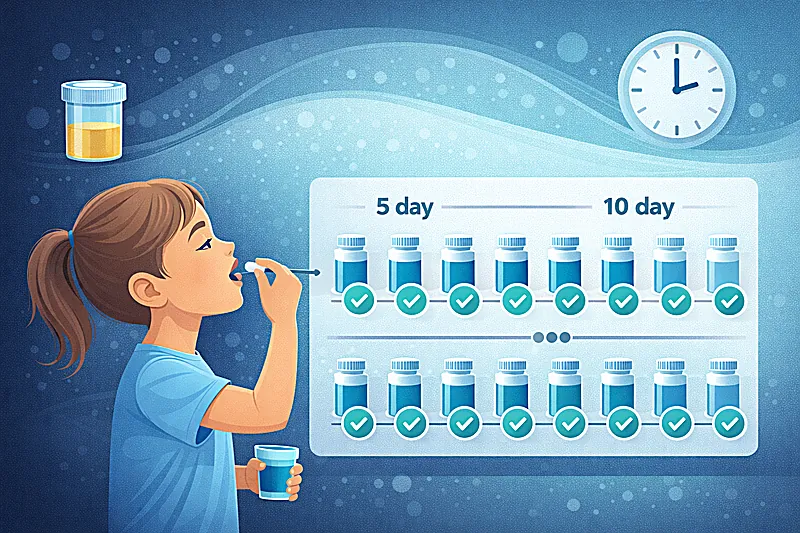
For adult women with uncomplicated cystitis, 3–5 day courses have been standard practice for decades. In pediatric medicine, however, tradition and caution around pyelonephritis-related renal scarring have kept most courses at 7–14 days. The last AAP guideline for infant UTI (2–24 months), retired in 2021, recommended 7–14 days. The 2024 Red Book now suggests 5–10 days for outpatient treatment and 3–5 days specifically for adolescents with simple cystitis. Two landmark randomised trials published in 2023–2024, together with three new meta-analyses, have substantially advanced the evidence base — making this an opportune moment for clinical reassessment.
What Evidence Was Reviewed
This synthesis draws on 11 studies published between 2002 and 2025, including 2 pivotal RCTs (SCOUT, STOP), 3 meta-analyses encompassing 9–17 individual trials each, 1 retrospective cohort study, 1 QI initiative, and contextual guideline documents. The evidence base includes over 3,500 children across the randomised trials and meta-analytic datasets.
| Study | Design | n | Population | Key Finding | Quality |
|---|---|---|---|---|---|
| SCOUT Trial (Zaoutis et al. 2023) | Multicentre RCT (noninferiority) | 664 | 2 mo–10 yrs, febrile + afebrile UTI | Treatment failure: 0.6% (10-day) vs 4.2% (5-day); noninferiority margin not met | High |
| STOP Trial (Montini et al. 2024) | Multicentre RCT (noninferiority) | 142 | 3 mo–5 yrs, febrile UTI only | 5-day amoxicillin-clavulanate noninferior to 10-day; similar recurrence at 30 days | Moderate |
| Mueller et al. 2025 | Meta-analysis (9 RCTs) | 1,171 | Children <18 yrs | UTI at end of therapy: RD 2.2% (95% CI 0.0–4.3); not significant | High (methods) |
| Barbosa Moreira et al. 2024 | Meta-analysis (17 RCTs) | 1,666 | Children <18 yrs | Short-course: higher failure (RR 1.61, 95% CI 1.15–2.27); no difference in reinfection | Moderate |
| Petricca et al. 2024 | Systematic review & meta-analysis (12 RCTs) | 1,442 | Children <18 yrs | Febrile UTI: cure favoured standard course (RR 0.97, p=0.01); afebrile: no difference | Moderate |
| Michael et al. 2003 (Cochrane) | Cochrane systematic review | 652 | Children 0–18 yrs | No difference in persistent bacteriuria between short and standard course | High (methods) |
| Afolabi et al. 2020 | Retrospective cohort | 791 | 6 mo–18 yrs | Short course (median 8 days) vs long (11 days): similar failure (OR 1.22, 95% CI 0.75–1.98) | Low |
| Kooner et al. 2024 | QI study (single ED) | NR | 5–18 yrs, afebrile UTI | Short-duration prescribing rose from 13% to >50%; no increase in 14-day revisits | Low |
| AAP Red Book 2024 | Clinical practice guideline | NR | All pediatric ages | Outpatient UTI: 5–10 days; adolescent cystitis: 3–5 days | Guideline |
| NICE 2018 (Pyelonephritis) | Clinical guideline | NR | Under 16 yrs | 7–10 days for pyelonephritis; 3 days for lower UTI in children >3 months | Guideline |
| Tramper-Stranders 2025 (Editorial) | Narrative review / editorial | NR | All pediatric ages | 3–5 days widely accepted for cystitis; febrile UTI data emerging but not definitive | Expert opinion |
Key Findings: Short-Course Antibiotics for Pediatric UTI
Afebrile (Lower) UTI: Evidence Supports Shorter Duration
The distinction between afebrile cystitis and febrile UTI (presumed pyelonephritis) is the most important factor in interpreting this evidence. For afebrile lower urinary tract infections, the data are converging: the Mueller 2025 meta-analysis found no statistically significant difference in UTI recurrence at the end of therapy between short-course and standard-course treatment. The Petricca 2024 systematic review similarly found equivalent cure rates in the afebrile subgroup (RR 0.99, 95% CI 0.91–1.08). NICE guidelines have endorsed 3-day treatment for lower UTI in children over 3 months since 2018, and the 2024 AAP Red Book now recommends 3–5 days for adolescent cystitis.
A paediatric ED quality improvement initiative reported by Kooner and colleagues increased short-duration prescribing for uncomplicated afebrile UTI in children aged 5–18 from 13% to over 50% — with no observable increase in 14-day revisit rates. These real-world implementation data add practical reassurance to the trial findings.
Febrile UTI: Promising Signals, Insufficient Power
The two landmark RCTs approach the febrile question differently. The SCOUT trial enrolled a mixed population — only 38% of participants had febrile UTIs — and was not powered to detect differences in the febrile subgroup alone. Its prespecified noninferiority margin of 5% was narrowly missed (absolute difference 3.6%, upper bound 95% CI 5.5%). However, a subgroup analysis (acknowledging it was underpowered) did not identify fever as a predictor of treatment failure.
The Italian STOP trial focused exclusively on febrile UTI in younger children (3 months to 5 years) and reported that 5-day amoxicillin-clavulanate was noninferior to 10-day treatment for 30-day recurrence. This trial enrolled only 142 children — far fewer than the planned 520 — and used a randomisation design that excluded complicated cases after 4 days of treatment. While the direction of evidence is favourable, the sample size limits definitive conclusions.
Three meta-analyses published in 2024–2025 offer partially conflicting conclusions, primarily because of differences in study inclusion criteria and analytic approaches. The Mueller 2025 meta-analysis (9 RCTs, n=1,171) used fixed-effects models and risk differences, finding no significant difference in UTI at end of therapy (RD 2.2%, 95% CI 0.0–4.3). When restricted to the two studies with febrile patients, the risk difference was only 0.4% (95% CI −2.8 to 3.6).
In contrast, the Barbosa Moreira 2024 meta-analysis (17 RCTs, n=1,666), which included older studies and used random-effects models with risk ratios, found that short-course therapy was associated with significantly higher treatment failure (RR 1.61, 95% CI 1.15–2.27). However, there was no difference in reinfection (RR 0.73, 95% CI 0.47–1.13) or relapse rates (RR 1.47, 95% CI 0.8–2.71).
The Petricca 2024 systematic review (12 RCTs, n=1,442) provided the clearest stratification: it found that standard-course treatment was associated with modestly better cure rates when febrile UTI studies were pooled (RR 0.97, 95% CI 0.95–0.99), but with high heterogeneity. For afebrile UTI, there was no difference in either cure or recurrence.
The apparent conflict largely resolves when the febrile/afebrile distinction is maintained. For afebrile cystitis, all three analyses support equivalence. For febrile UTI, the signal favours standard-course treatment, but the evidence base is small, the effect sizes are modest, and significant heterogeneity between studies limits confidence.
A recurring finding across the evidence is that short-course therapy is associated with higher rates of bacteriuria at the end of treatment — that is, bacteria are still detectable in the urine even though symptoms have resolved. The Mueller meta-analysis found a risk difference of 8.7% (95% CI 5.3–12.2) for bacteriuria favouring standard-course treatment.
However, the clinical significance of this finding is debated. Asymptomatic bacteriuria in children (as in adults) is common and generally does not require treatment. In the SCOUT trial, children with short-course treatment were more likely to have positive urine cultures at follow-up, but rates of subsequent symptomatic UTI beyond the first follow-up visit were equivalent between groups. This suggests that residual bacteriuria after short-course therapy may represent colonisation rather than treatment failure — a distinction with direct implications for whether test-of-cure cultures should be routinely obtained.
One of the primary motivations for reducing antibiotic duration is to limit selective pressure for resistant organisms. The SCOUT trial assessed gastrointestinal colonisation with resistant organisms and found no significant difference between 5-day and 10-day groups. However, this was measured at a single time point (days 11–14), and longer-term resistance effects were not evaluated.
The broader context is concerning: recent surveillance data indicate that multidrug-resistant uropathogens are increasingly common in paediatric populations, with prior antibiotic exposure in the preceding 30 days identified as an independent risk factor. From a population health perspective, reducing unnecessary antibiotic days — even by 5 days per course — could have meaningful cumulative effects on resistance selection when applied across millions of paediatric UTI episodes annually.
Children under 2 years represent the subgroup with the greatest concern for renal scarring from undertreated pyelonephritis, and paradoxically, the weakest evidence base for short-course therapy. The SCOUT trial included children as young as 2 months but was not designed to analyse this subgroup independently. The STOP trial enrolled from 3 months but had only 142 participants total, limiting age-stratified inference.
The now-retired AAP guideline for febrile UTI in infants aged 2–24 months recommended 7–14 days. No subsequent trial has specifically powered for this age group. An ongoing Danish trial (NCT05301023) is investigating individualised versus standard 10-day therapy in children 3 months to 12 years with febrile UTI, which may provide additional age-stratified data. Until that evidence is available, most experts recommend maintaining standard-course treatment for febrile UTI in children under 2 years.
Quality & Consistency of Evidence
What the Evidence Does NOT Show
No adequately powered RCT has evaluated short-course therapy specifically for febrile UTI in infants under 2 years of age — the subgroup at highest risk of renal scarring. The STOP trial was significantly underpowered (142 of 520 planned participants), and the SCOUT trial was not designed to isolate this population.
Several additional gaps warrant attention. No trial has compared 3-day versus 5-day courses in children — an important distinction since adult guidelines differentiate between these durations based on antibiotic class. The impact of antibiotic choice on optimal duration is underexplored; the SCOUT trial used various oral antibiotics while the STOP trial used amoxicillin-clavulanate exclusively, and whether lower-bioavailability agents such as oral cephalosporins require longer courses remains unclear.
Renal scarring outcomes have not been assessed in any of the short-course trials. The risk of scarring from undertreated pyelonephritis is the principal concern driving longer courses, yet no study has used DMSA scans or other imaging to compare scarring rates between treatment durations. Finally, no data exist on short-course therapy in children with known vesicoureteral reflux or other urinary tract anomalies — populations typically excluded from trials but commonly encountered in practice.
Practical Implications
Based on the current evidence, the following considerations may inform clinical decision-making. These are evidence-based observations, not directive recommendations, and should be weighed alongside patient age, fever status, clinical response, and local resistance patterns.
Multiple meta-analyses and guideline updates consistently support shortened treatment for uncomplicated lower UTI. The 2024 Red Book recommends 3–5 days for adolescent cystitis. Quality improvement data suggest this can be implemented safely in paediatric emergency settings.
Both the SCOUT and STOP trials observed low absolute treatment failure rates in the 5-day groups. For clinically improving children over 2 years with uncomplicated febrile UTI, the available evidence suggests that 5 days may be a reasonable duration, particularly when follow-up is reliable.
In the absence of age-specific trial data, the available evidence does not support shortening treatment duration in the highest-risk population. A 7–10 day course remains the most evidence-supported approach for febrile UTI in young infants.
The higher rate of asymptomatic bacteriuria after short-course treatment does not appear to translate into increased symptomatic recurrence. Routine test-of-cure urine cultures risk prompting unnecessary additional antibiotic courses for clinically irrelevant bacteriuria.
Evidence Grade & Bottom Line
Overall Evidence Grade: Moderate — Two RCTs, three meta-analyses, and supporting observational data provide consistent evidence that short-course antibiotics are effective for afebrile paediatric UTI. For febrile UTI in older children, the direction of evidence is favourable but the studies are underpowered. For febrile UTI in infants, data are insufficient. These conclusions may change as ongoing trials (Danish individualised-duration trial, NCT05301023) report results.
- For afebrile cystitis in children over 2 years, 3–5 days of oral antibiotics is as effective as standard-course treatment.
- For febrile UTI in children over 2 years who are clinically improving, 5-day therapy resulted in low failure rates in both the SCOUT and STOP trials.
- Shorter courses save over 300 antibiotic-days per 67 patients treated, with potential benefits for microbiome health and resistance selection.
- Key limitation: The febrile UTI evidence is underpowered, especially for infants under 2 years, who remain the population with the greatest potential harm from undertreated pyelonephritis.
- Residual bacteriuria after short-course therapy is common but does not appear to indicate treatment failure.
Article Information
For Educational Purposes Only. This is an original evidence synthesis informed by the studies listed below. It does not replace clinical judgement. Drug dosages should be verified against current prescribing information.
References
- Mueller GD, Conway SJ, Gibeau A, Shaikh N. Short- versus standard-course antimicrobial therapy for children with urinary tract infection: a meta-analysis. Acta Paediatr. 2025;114(3):479-486. DOI: 10.1111/apa.17546
- Zaoutis T, Shaikh N, Fisher BT, et al. Short-course therapy for urinary tract infections in children: the SCOUT randomized clinical trial. JAMA Pediatr. 2023;177(8):782-789. DOI: 10.1001/jamapediatrics.2023.1979
- Montini G, Tessitore A, Console K, et al; STOP Trial Group. Short oral antibiotic therapy for pediatric febrile urinary tract infections: a randomized trial. Pediatrics. 2024;153(1):e2023062598. DOI: 10.1542/peds.2023-062598
- Barbosa Moreira MV, Rezende de Freitas L, Mendes Fonseca L, et al. Shorter versus longer-course of antibiotic therapy for urinary tract infections in pediatric population: an updated meta-analysis. Eur J Pediatr. 2024;183(5):2037-2047. DOI: 10.1007/s00431-024-05512-8
- Petricca S, Schiavo L, Simeoni S, et al. Short- versus standard-course antibiotic therapy for urinary tract infection in children: a systematic review and meta-analysis. Pediatr Nephrol. 2024. DOI: 10.1007/s00467-024-06509-z
- Michael M, Hodson EM, Craig JC, Martin S, Moyer VA. Short compared with standard duration of antibiotic treatment for urinary tract infection: a systematic review of randomised controlled trials. Arch Dis Child. 2002;87(2):118-123. DOI: 10.1136/adc.87.2.118
- Afolabi TM, Goodlet KJ, Fairman KA. Association of antibiotic treatment duration with recurrence of uncomplicated urinary tract infection in pediatric patients. Ann Pharmacother. 2020;54(8):757-766. DOI: 10.1177/1060028019900650
- Kooner GK, Bass M, Saroha V, Gonzalez PJ, Jain S. Reducing antibiotic duration for uncomplicated UTI in the pediatric emergency department. Hosp Pediatr. 2024;14(4):265-271. DOI: 10.1542/hpeds.2023-007561
- Milstone AM, Tamma PD. Does the SCOUT trial fall short of determining an effective treatment duration for pediatric urinary tract infections? JAMA Pediatr. 2023;177(8):756-758. DOI: 10.1001/jamapediatrics.2023.1976
- Tramper-Stranders GA. Shorter treatments for (febrile) urinary tract infections: are we there? Transl Pediatr. 2025;14(1):1-3. DOI: 10.21037/tp-24-447
- American Academy of Pediatrics. Red Book: 2024–2027 Report of the Committee on Infectious Diseases. Itasca, IL: AAP; 2024. DOI: 10.1542/9781610027373
- National Institute for Health and Care Excellence. Urinary tract infection in under 16s: diagnosis and management. NICE guideline [NG109]. 2018 (updated 2022). Available at: nice.org.uk/guidance/ng109