
Acute Pancreatitis Management
Why current evidence favours moderate, goal-directed fluids and early enteral feeding over aggressive hydration and prolonged gut rest
One-Minute Takeaway
- Acute pancreatitis management has moved away from aggressive hydration and gut rest: randomised trials now support moderate, goal-directed fluid resuscitation and early enteral — preferably oral — feeding.
- The WATERFALL randomised trial was stopped early after aggressive lactated Ringer’s produced fluid overload in 20.5% of patients versus 6.3% with moderate resuscitation, without slowing disease progression.
- Pooled randomised evidence shows enteral nutrition lowers infection compared with parenteral nutrition (RR 0.45, 95% CI 0.26–0.78) and, in severe disease, is linked to lower mortality.
- The PYTHON trial found early nasoenteric tube feeding no better than an on-demand oral diet at 72 hours; most patients simply ate and avoided a feeding tube.
- Society guidelines endorse moderately aggressive lactated Ringer’s and early feeding — routine tubes and fixed high-volume fluids add risk without measurable benefit.
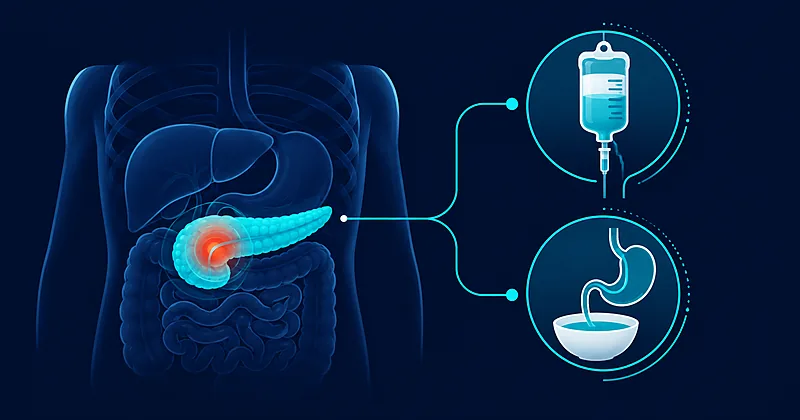
Why Acute Pancreatitis Management Matters
Acute pancreatitis is among the most common gastrointestinal reasons for hospital admission, and its incidence continues to climb. Roughly four in five episodes are mild and self-limiting. The remaining fifth progress to moderately severe or severe disease, where organ failure and infected necrosis drive most of the morbidity and death.
There is still no drug that treats the pancreatic injury itself. The first days of care therefore rest on a small number of supportive decisions: how much intravenous fluid to give, and whether, when, and how to feed. For a decade these choices were governed by two habits — flood the patient with fluid early, and rest the gut with nil-by-mouth or intravenous nutrition.
Both habits have since been tested directly. The results reshaped acute pancreatitis management around two linked ideas: give less fluid than tradition demanded, and feed sooner rather than later. This review weighs the randomised evidence behind that shift and where it stops short of certainty.
The Clinical Problem in Acute Pancreatitis Management
Two competing risks sit at the centre of early acute pancreatitis management. Intravascular volume can fall quickly as inflamed tissue leaks fluid, threatening perfusion of the pancreas, kidneys, and gut. That risk long justified large, rapid fluid boluses.
The opposing risk is iatrogenic. Excess fluid raises intra-abdominal pressure, worsens gas exchange, and can tip patients into overload. The same inflammatory leak that causes hypovolaemia also makes the interstitium unforgiving of over-resuscitation.
Nutrition carries a parallel tension. Prolonged fasting was thought to rest the pancreas, but it also weakens the gut barrier. A failing barrier lets luminal bacteria translocate and seed pancreatic necrosis — the event most strongly tied to death in severe disease. Feeding early may protect the barrier; feeding badly may cause aspiration or intolerance.
Sound acute pancreatitis management is therefore a balancing act rather than a maximal intervention. The three approaches below map onto the three decisions clinicians actually make in the first 72 hours.
Available Approaches
The comparative table summarises the trials and syntheses that anchor current practice. Every sample size, effect estimate, and confidence interval was drawn from the primary source or a systematic review, not from prior knowledge.
| Study / Source | Design | N | Population | Comparison | Key result |
|---|---|---|---|---|---|
| WATERFALL (de-Madaria 2022) | Multicentre RCT (stopped early for safety) | 249 | Acute pancreatitis, presenting <24 h | Moderate vs aggressive lactated Ringer’s | Progression to moderate/severe disease 17.3% vs 22.1% (aRR 1.30, 95% CI 0.78–2.18); fluid overload 6.3% vs 20.5% (aRR 2.85, 95% CI 1.36–5.94) |
| Buxbaum 2017 | Single-centre RCT | 60 | Mild acute pancreatitis, no SIRS | Aggressive vs standard lactated Ringer’s | Faster clinical improvement with aggressive (adjusted HR 2.32, 95% CI 1.21–4.45); less persistent SIRS (aOR 0.12, 95% CI 0.02–0.94); no overload observed |
| Marik & Zaloga 2004 | Systematic review / meta-analysis (6 RCTs) | 263 | Acute pancreatitis | Enteral vs parenteral nutrition | Infection RR 0.45 (95% CI 0.26–0.78); mortality RR 0.66 (95% CI 0.32–1.37, not significant) |
| Wu 2018 | Systematic review / meta-analysis (11 RCTs) | 562 | Severe acute pancreatitis | Enteral vs parenteral nutrition | Mortality RR 0.43 (95% CI 0.23–0.78); infection and complications RR 0.53 (95% CI 0.39–0.71); organ failure RR 0.63 (95% CI 0.39–1.02) |
| Li 2013 | Systematic review / meta-analysis (11 studies) | 775 | Acute pancreatitis (mild to severe) | Enteral nutrition <48 h vs later | All infections OR 0.38 (95% CI 0.21–0.68); mortality OR 0.31 (95% CI 0.14–0.71); shorter stay (mean difference −2.18 days) |
| Song 2018 | Systematic review / meta-analysis (10 RCTs) | 1,051 | Severe / predicted-severe acute pancreatitis | Early enteral (<48 h) vs late enteral or parenteral | Mortality RR 0.53 (95% CI 0.35–0.81); organ failure RR 0.58 (95% CI 0.43–0.77); systemic infection RR 0.75 (95% CI 0.61–0.93) |
| PYTHON (Bakker 2014) | Multicentre RCT | 208 | Predicted-severe acute pancreatitis | Early nasoenteric tube (<24 h) vs on-demand oral diet at 72 h | Composite major infection or death 30% vs 27% (RR 1.07, 95% CI 0.79–1.44); about two-thirds of the oral group avoided a feeding tube |
RCT = randomised controlled trial; aRR = adjusted relative risk; HR = hazard ratio; OR = odds ratio; RR = relative risk; SIRS = systemic inflammatory response syndrome. Figures verified against primary sources or systematic reviews.
Approach 1 — Fluid resuscitation strategy
WATERFALL directly compared moderate and aggressive lactated Ringer’s in patients presenting within 24 hours. The trial found no reduction in progression to moderate or severe disease with the aggressive regimen. It did find harm: aggressive resuscitation resulted in markedly more fluid overload, and the safety board halted enrolment early.
An earlier and smaller trial complicates the picture. In mild disease without SIRS, Buxbaum and colleagues reported that aggressive early hydration hastened clinical improvement, with no overload seen. The two results are best reconciled by population and protocol: WATERFALL’s aggressive arm delivered a fixed high volume regardless of volume status, whereas Buxbaum’s design escalated fluid only when laboratory markers worsened.
The practical reading is that early hydration matters, but its dose should track the patient, not a formula. Guidelines have converged on this “moderately aggressive,” goal-directed position with lactated Ringer’s as the preferred crystalloid.
Approach 2 — Route of nutrition: enteral versus parenteral
The choice between feeding the gut and bypassing it is the most settled question here. Across meta-analyses of randomised trials, enteral nutrition lowered infectious complications relative to parenteral nutrition. In the pooled acute pancreatitis data, the reduction in infection was substantial and statistically robust.
In severe disease the signal extends to mortality. Wu and colleagues found enteral feeding associated with lower death rates than parenteral feeding, alongside fewer infections. The mechanism is thought to be preservation of the gut barrier, which parenteral nutrition does not support.
Parenteral nutrition retains a narrow role — when the enteral route cannot meet needs or is not tolerated — but it is no longer a first choice in acute pancreatitis management.
Approach 3 — Timing and mode of early feeding
Two threads run through the timing evidence, and they point in subtly different directions. Meta-analyses of early enteral nutrition, started within 48 hours, report fewer infections, less organ failure, and lower mortality when the comparator is delayed feeding or parenteral nutrition. Song and colleagues found consistent benefit in severe and predicted-severe disease.
PYTHON tested a stricter question: does a nasoenteric tube placed within 24 hours beat simply offering food on demand and starting an oral diet at 72 hours? It did not. Rates of infection and death were similar, and roughly two-thirds of the on-demand group tolerated oral intake and never needed a tube.
Read together, the message is that early feeding beats prolonged fasting, but the delivery need not be aggressive. Where the mouth works, use it; where a tube is needed, nasogastric and nasojejunal routes perform comparably.
Clinical Pearl
“Early feeding” and “early tube feeding” are not the same intervention. The benefit of early enteral nutrition is largely captured by letting patients eat when they can. A feeding tube is a fallback for intolerance or severe disease, not a default first step.
Comparative Analysis
Placing the fluid and nutrition evidence side by side reveals a common theme: the older, more forceful option rarely outperformed the gentler one, and sometimes underperformed it. The three figures below capture the pivots that changed practice.
On fluids, the strongest direct evidence favours restraint. A single randomised comparison showed no benefit and clear harm from higher volumes, and the small trial suggesting benefit did so only in mild disease using a responsive, escalate-as-needed protocol.
On nutrition route, the direction is consistent across every synthesis: the gut-feeding strategy lowers infection, and in severe disease it is associated with lower mortality. This is the most reproducible finding in the field.
On feeding timing, the nuance matters. Early enteral nutrition helps when the alternative is fasting or a drip. It does not help when the alternative is simply eating on demand. Aggressiveness of delivery, not earliness alone, is where added risk creeps in.
Quality and Consistency of the Evidence
Strength of evidence varies sharply by question. The list below rates each outcome by the quality and agreement of the underlying studies.
- Enteral over parenteral nutrition (infection). Multiple randomised trials and meta-analyses agree on lower infection with enteral feeding. Effects are consistent in direction and magnitude.
- Moderate over aggressive fluid resuscitation. One well-conducted randomised trial shows harm from higher volumes, reinforced by guideline consensus — but it was stopped early, and one small trial conflicts in mild disease.
- Early enteral over delayed or parenteral feeding (severe disease). Several meta-analyses concur, yet many pooled trials are small, single-centre, and heterogeneous, which tempers confidence in the mortality estimates.
- Enteral over parenteral nutrition (mortality). The mortality benefit is significant in severe-disease syntheses but rests on smaller, older trials; the acute-pancreatitis-wide estimate did not reach significance.
- Early tube feeding within 24 hours. The one adequately designed randomised trial was neutral and arguably underpowered; routine early tube placement is not supported.
What the Evidence Does Not Show
Several practical questions remain genuinely unresolved, and it helps to name them precisely rather than gesture at uncertainty.
Specific evidence gaps
The optimal ceiling and stopping point for lactated Ringer’s are undefined — trials fixed the rate but not a clear endpoint of resuscitation. The best crystalloid remains debated, and a head-to-head trial of saline versus lactated Ringer’s is ongoing. Ideal calorie and protein targets in the first days are untested, with a dedicated energy-dose trial still awaited. The value of immunonutrition and probiotics is unproven and, in one landmark trial, probiotics increased harm. Finally, the timing question has not been settled in true established severe pancreatitis, where most patients cannot eat on demand and the on-demand comparator from PYTHON may not apply.
None of these gaps overturns the core direction of travel. They define where clinical judgement, rather than trial data, still governs acute pancreatitis management.
Practical Implications
The evidence supports a coherent early pathway, framed as what the data endorse rather than as directives.
Fluids. Start lactated Ringer’s promptly at a moderate, goal-directed rate, adding boluses when hypovolaemia is evident. Reassess perfusion within the first several hours and again over the next day or two, and step down once the patient stabilises. Watch for overload, especially in older patients and those with cardiac or renal disease.
Route of nutrition. Prefer the enteral route whenever the gut is usable. Reserve parenteral nutrition for patients who cannot meet needs enterally, rather than using it to rest the pancreas.
Timing and mode. Offer feeding early rather than imposing prolonged fasting. In mild disease, a low-fat solid oral diet can begin as tolerated, without a mandatory liquid-to-solid progression. Reserve nasoenteric tubes for patients who cannot eat, with nasogastric and nasojejunal routes both acceptable.
This pathway aligns with current society guidance and, importantly for surgical teams, reduces the fluid-overload and line-related complications that historically followed aggressive early care.
Evidence Grade and Bottom Line
Overall grade: Moderate. The direction of the evidence is consistent and guideline-endorsed, but several pivotal findings rest on single trials, early stoppage, or small pooled studies.
Two conclusions are well supported. Enteral nutrition lowers infection compared with parenteral nutrition, and moderate goal-directed fluid resuscitation avoids the overload seen with fixed high-volume regimens without sacrificing outcomes.
One conclusion is more cautious. Early feeding is beneficial relative to fasting, but forcing a nasoenteric tube within 24 hours adds nothing over letting stable patients eat on demand.
For everyday acute pancreatitis management, the safest evidence-aligned default is restraint on fluids and permissiveness on feeding: lactated Ringer’s at a measured rate, and the enteral route used early and, where possible, by mouth.
Article Information and References
Specialty: Surgery. Content type: Evidence Review. This review synthesises randomised trials, systematic reviews, and society guidelines on fluid resuscitation and nutrition in acute pancreatitis.
- Wu P, Li L, Sun W. Efficacy comparisons of enteral nutrition and parenteral nutrition in patients with severe acute pancreatitis: a meta-analysis from randomized controlled trials. Biosci Rep. 2018;38(6):BSR20181515. DOI: https://doi.org/10.1042/BSR20181515
- Song J, Zhong Y, Lu X, et al. Enteral nutrition provided within 48 hours after admission in severe acute pancreatitis: a systematic review and meta-analysis. Medicine (Baltimore). 2018;97(34):e11871. DOI: https://doi.org/10.1097/MD.0000000000011871
- Li JY, Yu T, Chen GC, et al. Enteral nutrition within 48 hours of admission improves clinical outcomes of acute pancreatitis by reducing complications: a meta-analysis. PLoS One. 2013;8(6):e64926. DOI: https://doi.org/10.1371/journal.pone.0064926
- Marik PE, Zaloga GP. Meta-analysis of parenteral nutrition versus enteral nutrition in patients with acute pancreatitis. BMJ. 2004;328(7453):1407. DOI: https://doi.org/10.1136/bmj.38118.593900.55
- de-Madaria E, Buxbaum JL, Maisonneuve P, et al. Aggressive or moderate fluid resuscitation in acute pancreatitis. N Engl J Med. 2022;387(11):989–1000. DOI: https://doi.org/10.1056/NEJMoa2202884
- Bakker OJ, van Brunschot S, van Santvoort HC, et al. Early versus on-demand nasoenteric tube feeding in acute pancreatitis. N Engl J Med. 2014;371(21):1983–1993. DOI: https://doi.org/10.1056/NEJMoa1404393
- Buxbaum JL, Quezada M, Da B, et al. Early aggressive hydration hastens clinical improvement in mild acute pancreatitis. Am J Gastroenterol. 2017;112(5):797–803. DOI: https://doi.org/10.1038/ajg.2017.40
- Tenner S, Vege SS, Sheth SG, et al. American College of Gastroenterology guidelines: management of acute pancreatitis. Am J Gastroenterol. 2024;119(3):419–437. DOI: https://doi.org/10.14309/ajg.0000000000002645
- Crockett SD, Wani S, Gardner TB, et al. American Gastroenterological Association Institute guideline on initial management of acute pancreatitis. Gastroenterology. 2018;154(4):1096–1101. DOI: https://doi.org/10.1053/j.gastro.2018.01.032
- Vege SS, DiMagno MJ, Forsmark CE, et al. Initial medical treatment of acute pancreatitis: American Gastroenterological Association Institute technical review. Gastroenterology. 2018;154(4):1103–1139. DOI: https://doi.org/10.1053/j.gastro.2018.01.031