
Bariatric Surgery Outcomes in the GLP-1 Era: Sleeve, RYGB, and Pharmacotherapy Compared
An evidence synthesis of long-term randomised data from SLEEVEPASS and SM-BOSS, the STAMPEDE metabolic trial, and emerging head-to-head comparisons with semaglutide and tirzepatide.
One-Minute Takeaway on Bariatric Surgery Outcomes
One-Minute Takeaway
- Bariatric surgery outcomes at 5 to 10 years remain durable for both sleeve gastrectomy and Roux-en-Y gastric bypass, with RYGB showing modestly greater excess weight loss in long-term randomised follow-up.
- SLEEVEPASS reported 10-year %EWL of 43.5% after sleeve versus 51.9% after RYGB; SM-BOSS demonstrated similar though non-significant differences at 5 years and beyond.
- RYGB consistently shows higher rates of type 2 diabetes remission and lower rates of de novo gastroesophageal reflux compared with sleeve gastrectomy across long-term randomised data.
- Real-world comparisons suggest bariatric surgery delivers approximately five-fold greater 2-year weight loss than weekly semaglutide or tirzepatide, but pharmacotherapy retains a defined role in selected and post-surgical patients.
- Important uncertainties remain regarding optimal sequencing of GLP-1 receptor agonists with surgery, durability of pharmacotherapy on discontinuation, and long-term cardiovascular endpoints in pharmacotherapy alone.
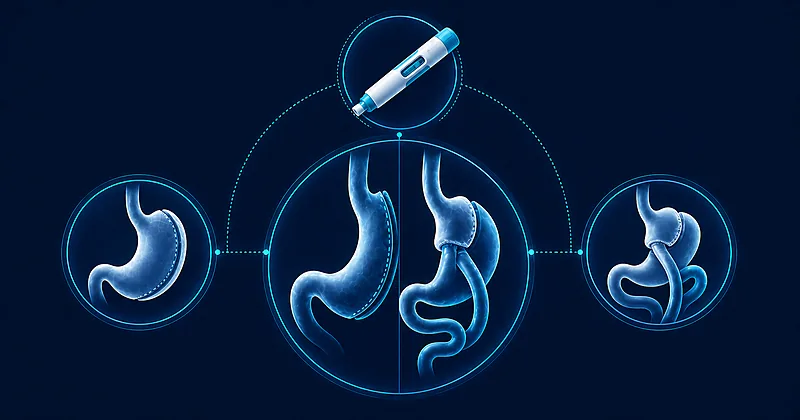
Why Bariatric Surgery Outcomes Matter Now
Severe obesity remains a leading driver of cardiometabolic disease, yet the therapeutic landscape has shifted dramatically with the rapid uptake of glucagon-like peptide-1 (GLP-1) and dual GLP-1/GIP receptor agonists. Clinicians, payers, and patients increasingly ask which approach delivers the most durable benefit, at what cost, and for whom.
Long-term bariatric surgery outcomes are now anchored by mature randomised evidence. The SLEEVEPASS and SM-BOSS trials have produced 5- to 10-year follow-up comparing sleeve gastrectomy with Roux-en-Y gastric bypass. The STAMPEDE trial established that surgery is more effective than intensive medical therapy for type 2 diabetes through 5 years.
Three contemporary forces shape modern interpretation of bariatric surgery outcomes: the maturation of long-term randomised data on sleeve versus RYGB; the entry of highly effective GLP-1 and GIP/GLP-1 agents into routine practice; and the recognition that surgery and pharmacotherapy may be complementary rather than substitutive. Each is examined below.
What Evidence Was Reviewed
This synthesis draws on landmark randomised trials comparing sleeve gastrectomy with Roux-en-Y gastric bypass, the STAMPEDE metabolic surgery trial, a one-stage meta-analysis of long-term mortality, the foundational STEP-1 and SURMOUNT-1 GLP-1/GIP-RA trials, and recent real-world head-to-head comparisons of bariatric surgery outcomes against modern pharmacotherapy.
Studies were selected for the strength of their design, the duration of follow-up, and direct relevance to contemporary patient selection. Priority was given to randomised trials with ≥5-year follow-up, large registry analyses with adjusted comparisons, and the 2022 ASMBS/IFSO indications update that frames eligibility criteria. The summary table of bariatric surgery outcomes evidence appears below.
| Study / Source | Design | Population (n) | Comparison | Key Outcome |
|---|---|---|---|---|
| SLEEVEPASS 10-year (Salminen 2022) | Multicentre RCT, observational extension | 240 (LSG 121 vs LRYGB 119) | Sleeve vs RYGB | 10-yr %EWL 43.5% vs 51.9% |
| SM-BOSS 5-year (Peterli 2018) | Multicentre RCT | 217 (LSG 107 vs LRYGB 110) | Sleeve vs RYGB | 5-yr %EBMIL 61.1% vs 68.3% (NS) |
| SM-BOSS 10-year (Wölnerhanssen 2025) | RCT long-term follow-up | 217 (originally randomised) | Sleeve vs RYGB at ≥10 yr | Durable weight loss; metabolic outcomes favour RYGB |
| STAMPEDE 5-year (Schauer 2017) | Single-centre RCT | 150 (T2D, BMI 27–43) | Surgery vs intensive medical | HbA1c ≤6% in 29% RYGB vs 23% sleeve vs 5% medical |
| Syn 2021 (Lancet) | One-stage meta-analysis matched cohorts | 174,772 | Surgery vs nonsurgical | Median life expectancy gain ~6.1 yr |
| STEP-1 (Wilding 2021) | Phase 3 RCT | 1,961 | Semaglutide 2.4 mg vs placebo | 68-wk weight change −14.9% vs −2.4% |
| SURMOUNT-1 (Jastreboff 2022) | Phase 3 RCT | 2,539 | Tirzepatide 5/10/15 mg vs placebo | 72-wk weight change up to −20.9% |
| Brown / ASMBS 2025 (NYU real-world) | Retrospective comparative effectiveness | 51,085 | Surgery vs GLP-1 RA | 2-yr %TWL 24% vs 4.7% |
| Jensen 2023 (Obes Surg) | Retrospective observational | 50 (post-bariatric weight regain) | GLP-1 RA after sleeve/RYGB | ~67% of regained weight reversed at 6 mo |
| Eisenberg 2022 (ASMBS/IFSO) | Guideline update | — | Indications for metabolic surgery | BMI ≥35 alone; BMI 30–34.9 with metabolic disease |
| Arterburn 2020 (JAMA review) | Narrative review of risks/benefits | — | Bariatric surgery overview | Mortality 0.1–0.3%; major complications 4% |
| Medhati 2025 (Ann Surg) | Single-centre real-world cohort | 1,072 | Semaglutide ± prior bariatric surgery | 1-yr %TWL 8.8% (mean); discontinuation 25% |
Key Findings on Bariatric Surgery Outcomes Synthesised by Theme
Five themes emerge from the synthesis of long-term randomised trials, large matched cohorts, and contemporary pharmacotherapy data on bariatric surgery outcomes. They span weight-loss durability, metabolic effects, mortality, the role of GLP-1 and GIP/GLP-1 agonists, and the evolving sequencing of surgery with pharmacotherapy.
Theme 1 — Long-Term Weight Loss: Sleeve vs RYGB
SLEEVEPASS and SM-BOSS together provide the strongest randomised evidence on long-term bariatric surgery outcomes for the two dominant procedures. SLEEVEPASS reported 10-year mean estimated %EWL of 43.5% after sleeve versus 51.9% after RYGB, a statistically significant advantage for RYGB but within the equivalence margin set by the trial.
SM-BOSS at 5 years showed %EBMIL of 61.1% after sleeve versus 68.3% after RYGB, a numerical but non-significant difference. Across both trials, both procedures produced clinically meaningful and durable weight loss, with RYGB showing a small consistent advantage that widens slightly with longer follow-up.
Theme 2 — Metabolic Effects and Type 2 Diabetes Remission
The STAMPEDE trial randomised patients with type 2 diabetes and BMI 27–43 to RYGB, sleeve gastrectomy, or intensive medical therapy. At 5 years, 29% of RYGB and 23% of sleeve patients achieved HbA1c of 6.0% or lower versus 5% in the medical-therapy arm.
Across SLEEVEPASS and SM-BOSS long-term follow-up, RYGB showed numerically higher rates of type 2 diabetes remission and superior hypertension remission. Sleeve gastrectomy is more frequently associated with de novo or worsening gastroesophageal reflux, which is a defining trade-off in modern bariatric surgery outcomes assessment and a recurring driver of conversion procedures.
Theme 3 — Long-Term Mortality and Survival
The 2021 one-stage meta-analysis by Syn and colleagues pooled 174,772 patients from matched-cohort and prospective controlled studies. Bariatric surgery was associated with a hazard ratio for all-cause mortality of approximately 0.51 versus nonsurgical controls and a median life expectancy gain of 6.1 years.
Effect sizes were larger in patients with type 2 diabetes (life expectancy gain ~9.3 years) than in those without (~5.1 years). These findings, while observational and subject to confounding by indication, are remarkably consistent across geographies and surgical eras and provide the strongest available signal that durable bariatric surgery outcomes translate into long-term survival benefit.
Theme 4 — GLP-1 and GIP/GLP-1 Agonists Reset the Comparator
STEP-1 demonstrated that semaglutide 2.4 mg subcutaneous weekly produced 14.9% mean weight loss at 68 weeks versus 2.4% with placebo. SURMOUNT-1 showed that tirzepatide 15 mg achieved approximately 20.9% mean weight loss at 72 weeks. These magnitudes approach but do not match the 25–30% sustained loss typical of bariatric surgery.
In the 2025 NYU real-world head-to-head presented at ASMBS, sleeve and RYGB produced approximately 24% total weight loss at 2 years versus 4.7% for semaglutide or tirzepatide users prescribed at least 6 months of therapy. Real-world pharmacotherapy effectiveness is markedly lower than trial-reported figures, reflecting access, adherence, and discontinuation challenges.
Theme 5 — Sequencing GLP-1 RA with Surgery
A consistent observation is that 20–25% of bariatric surgery patients experience clinically significant weight regain by 5–10 years. The Jensen 2023 cohort showed that GLP-1 RA therapy reversed approximately two-thirds of post-surgical weight regain at 6 months in non-diabetic patients. Larger prospective trials are ongoing.
Whether GLP-1 RA bridging before or after surgery improves long-term bariatric surgery outcomes remains incompletely characterised. Real-world data suggest pharmacotherapy is increasingly used both as a primary obesity treatment and as adjunct to maintain weight loss after surgery, particularly after sleeve gastrectomy where late regain is more common.
Synthesis pearl: Modern decision-making on bariatric surgery outcomes integrates four questions: (1) what is the patient’s metabolic disease burden? (2) is GERD a baseline issue that argues against sleeve? (3) what is the realistic adherence horizon for chronic pharmacotherapy? (4) can the two modalities be sequenced or combined to maximise durable benefit?
Quality & Consistency of Evidence
The evidence base supporting bariatric surgery outcomes is mature for the surgical comparators and rapidly evolving for the head-to-head comparison with modern pharmacotherapy. The colored ratings below reflect study design strength, replication, and consistency of effect across populations, with a focus on long-term bariatric surgery outcomes that matter most to clinicians and patients.
What the Evidence Does Not Show
Despite mature randomised data on sleeve and RYGB, several clinically important questions about contemporary bariatric surgery outcomes remain unsettled. Acknowledging these gaps protects against overconfident extrapolation, particularly when patients ask about choosing surgery versus modern pharmacotherapy.
Many of the open questions cluster around the rapidly changing pharmacotherapy landscape, the absence of randomised head-to-head trials at sufficient duration, and the unknown durability of medication-based weight loss when therapy is discontinued, deprescribed, or limited by access and cost.
Specific Knowledge Gaps
- Randomised head-to-head surgery vs GLP-1 RA at ≥3 years. No published RCT directly compares sleeve or RYGB with semaglutide or tirzepatide for weight, metabolic, and cardiovascular endpoints over the long term.
- Durability of pharmacotherapy after discontinuation. STEP-4 and STEP-1 extension data show substantial weight regain after stopping semaglutide; comparable long-term durability data for tirzepatide are still maturing.
- Optimal sequencing of GLP-1 RA with surgery. Whether preoperative pharmacotherapy improves perioperative or long-term outcomes, and whether postoperative GLP-1 RA prevents late regain in unselected patients, lacks adequately powered prospective evidence.
- Cardiovascular outcomes. The SELECT trial established cardiovascular benefit of semaglutide in obesity with established CVD; comparable cardiovascular outcome trials for bariatric surgery are observational.
- Adolescent bariatric surgery outcomes ≥10 years. Teen-LABS provides important 5-year data; very long-term effects on bone health, fertility, and pregnancy outcomes remain incompletely defined.
- Cost-effectiveness in the GLP-1 era. Comparative cost-effectiveness models that incorporate real-world adherence, drug pricing volatility, and surgical complication risk are still preliminary.
Practical Implications for Bariatric Surgery Outcomes
Based on the current evidence, decisions about bariatric surgery outcomes should be framed as evidence-supported considerations rather than rigid algorithms. Patient-level factors, baseline metabolic disease, GERD status, expectations around adherence, and access to chronic pharmacotherapy all modify the synthesised positions below.
The four cards summarise the highest-confidence applications. The accordions that follow address adjacent operational issues — preoperative GLP-1 RA, post-surgical weight regain, and perioperative considerations — that recur in routine bariatric surgery outcomes discussions in 2026.
Preoperative GLP-1 RA has become common practice for patients seeking bariatric surgery, often used to facilitate weight loss before operation or to satisfy insurance preauthorisation. Prospective data on whether this improves perioperative or long-term bariatric surgery outcomes are limited.
Anaesthesia societies have advised holding GLP-1 RA before elective surgery to mitigate aspiration risk from delayed gastric emptying, although recent evidence suggests this concern may be overstated when fasting protocols are observed. Local pathways should follow current institutional and society guidance.
Sleeve gastrectomy is now the most performed bariatric procedure worldwide, owing to a shorter operation, simpler post-operative nutritional management, and a lower rate of internal hernia or marginal ulcer. RYGB retains advantages for patients with severe baseline GERD, established type 2 diabetes, or where the modest long-term weight-loss advantage matters most.
Patient preference and surgeon expertise reasonably influence procedure choice, but baseline GERD argues strongly against sleeve in most contemporary algorithms. Conversion from sleeve to RYGB for refractory reflux or weight regain is increasingly common.
Realistic counselling helps align expectations with evidence on bariatric surgery outcomes. A typical sleeve patient can expect 20–25% total weight loss at 1–2 years, settling to ~18–20% at 10 years. RYGB delivers ~25–30% at peak, often settling near 25% long-term.
Modern pharmacotherapy delivers ~15–21% in trials and considerably less in real-world practice, requires indefinite continuation for sustained effect, and currently faces access and cost challenges. Patients deciding between approaches benefit from explicit discussion of these durability and adherence trade-offs.
Evidence Grade & Bottom Line
Evidence Grade — Strong (long-term sleeve vs RYGB outcomes; pharmacotherapy efficacy in non-surgical populations); Moderate (surgery vs medical therapy for type 2 diabetes; long-term survival benefit of surgery); Limited (head-to-head surgery vs modern GLP-1 RA; sequencing strategies).
Bottom Line
- Both sleeve gastrectomy and Roux-en-Y gastric bypass produce durable long-term weight loss, with RYGB showing a small but consistent advantage in randomised follow-up at 5 to 10 years.
- RYGB more often achieves type 2 diabetes remission and avoids de novo gastroesophageal reflux, while sleeve offers technical simplicity and lower perioperative morbidity.
- Modern GLP-1 and GIP/GLP-1 receptor agonists deliver robust trial-level weight loss but real-world effectiveness lags behind, and durability requires ongoing therapy.
- In current real-world data, bariatric surgery delivers approximately five-fold greater 2-year weight loss than semaglutide or tirzepatide, supporting surgery as the most effective single intervention for severe obesity.
- Optimal sequencing of pharmacotherapy with surgery, durability of pharmacotherapy on discontinuation, and randomised head-to-head data at sufficient follow-up remain open questions that should temper definitive recommendations.
Article Information & References
Disclaimer
For Educational Purposes Only. This is an original evidence synthesis informed by the studies listed below. It does not replace clinical judgement. Drug dosages should be verified against current prescribing information.
References
- Salminen P, Grönroos S, Helmiö M, et al. Effect of Laparoscopic Sleeve Gastrectomy vs Roux-en-Y Gastric Bypass on Weight Loss, Comorbidities, and Reflux at 10 Years in Adult Patients With Obesity: The SLEEVEPASS Randomized Clinical Trial. JAMA Surg. 2022;157(8):656-666. DOI: 10.1001/jamasurg.2022.2229
- Peterli R, Wölnerhanssen BK, Peters T, et al. Effect of Laparoscopic Sleeve Gastrectomy vs Laparoscopic Roux-en-Y Gastric Bypass on Weight Loss in Patients With Morbid Obesity: The SM-BOSS Randomized Clinical Trial. JAMA. 2018;319(3):255-265. DOI: 10.1001/jama.2017.20897
- Wölnerhanssen BK, Peterli R, Hurme S, et al. Long-Term Outcomes of Laparoscopic Roux-en-Y Gastric Bypass vs Laparoscopic Sleeve Gastrectomy for Obesity: The SM-BOSS Randomized Clinical Trial. JAMA Surg. 2025. DOI: 10.1001/jamasurg.2024.6433
- Schauer PR, Bhatt DL, Kirwan JP, et al. Bariatric Surgery versus Intensive Medical Therapy for Diabetes — 5-Year Outcomes. N Engl J Med. 2017;376(7):641-651. DOI: 10.1056/NEJMoa1600869
- Syn NL, Cummings DE, Wang LZ, et al. Association of metabolic-bariatric surgery with long-term survival in adults with and without diabetes: a one-stage meta-analysis of matched cohort and prospective controlled studies with 174,772 participants. Lancet. 2021;397(10287):1830-1841. DOI: 10.1016/S0140-6736(21)00591-2
- Wilding JPH, Batterham RL, Calanna S, et al. Once-Weekly Semaglutide in Adults with Overweight or Obesity. N Engl J Med. 2021;384(11):989-1002. DOI: 10.1056/NEJMoa2032183
- Jastreboff AM, Aronne LJ, Ahmad NN, et al. Tirzepatide Once Weekly for the Treatment of Obesity (SURMOUNT-1). N Engl J Med. 2022;387(3):205-216. DOI: 10.1056/NEJMoa2206038
- Eisenberg D, Shikora SA, Aarts E, et al. 2022 American Society for Metabolic and Bariatric Surgery (ASMBS) and International Federation for the Surgery of Obesity and Metabolic Disorders (IFSO): Indications for Metabolic and Bariatric Surgery. Surg Obes Relat Dis. 2022;18(12):1345-1356. DOI: 10.1016/j.soard.2022.08.013
- Arterburn DE, Telem DA, Kushner RF, Courcoulas AP. Benefits and Risks of Bariatric Surgery in Adults: A Review. JAMA. 2020;324(9):879-887. DOI: 10.1001/jama.2020.12567
- Jensen AB, Renström F, Aczél S, et al. Efficacy of the Glucagon-Like Peptide-1 Receptor Agonists Liraglutide and Semaglutide for the Treatment of Weight Regain After Bariatric Surgery: a Retrospective Observational Study. Obes Surg. 2023;33(4):1017-1025. DOI: 10.1007/s11695-023-06484-8
- Lincoff AM, Brown-Frandsen K, Colhoun HM, et al. Semaglutide and Cardiovascular Outcomes in Obesity without Diabetes (SELECT). N Engl J Med. 2023;389(24):2221-2232. DOI: 10.1056/NEJMoa2307563
- Medhati P, Shin TH, Wasden K, et al. GLP-1RA in the Real World: 1-year Compliance and Outcomes of Semaglutide Use in Patients With or Without Previous History of Bariatric Surgery. Ann Surg. 2025. DOI: 10.1097/SLA.0000000000006748