
NPWT on Closed Surgical Incisions: When Does It Help?
A synthesis of 57 RCTs encompassing 13,744 patients evaluating incisional negative pressure wound therapy for surgical site infection prevention — identifying which patients and procedures benefit most, through 2026.
This is an original evidence synthesis. See References for source studies.
One-Minute Takeaway
One-Minute Takeaway
- NPWT on closed surgical incisions reduces surgical site infection by 33% overall (RR 0.67, 95% CI 0.59–0.76) across 57 RCTs with 13,744 patients — with high-certainty evidence and trial sequential analysis confirming this benefit is robust (de Smet 2023).
- The benefit is most pronounced in high-risk populations: vascular groin incisions (OR 0.39), orthopaedic trauma (significant reduction in deep and superficial SSI), obese women after caesarean section (RR 0.79), and laparotomy wounds in general/colorectal surgery.
- Evidence for seroma reduction is consistent (RR 0.48 in early meta-analyses), while impact on wound dehiscence is inconsistent across studies and surgical contexts.
- Cost-effectiveness data remain sparse, and no RCT has yet definitively identified a risk threshold below which incisional NPWT offers no meaningful benefit — limiting adoption in standard-risk populations.
Why This Topic Matters
Surgical site infection remains one of the most common healthcare-associated complications, affecting approximately 2–5% of all surgical procedures and up to 10–15% of high-risk operations. The consequences extend beyond acute morbidity: SSIs increase hospital stay, drive readmissions, raise the risk of incisional hernia, and impose substantial economic costs estimated at billions of dollars annually across healthcare systems. Conventional wound dressings — sterile gauze, adhesive films — serve primarily as passive barriers, offering no active contribution to wound healing.
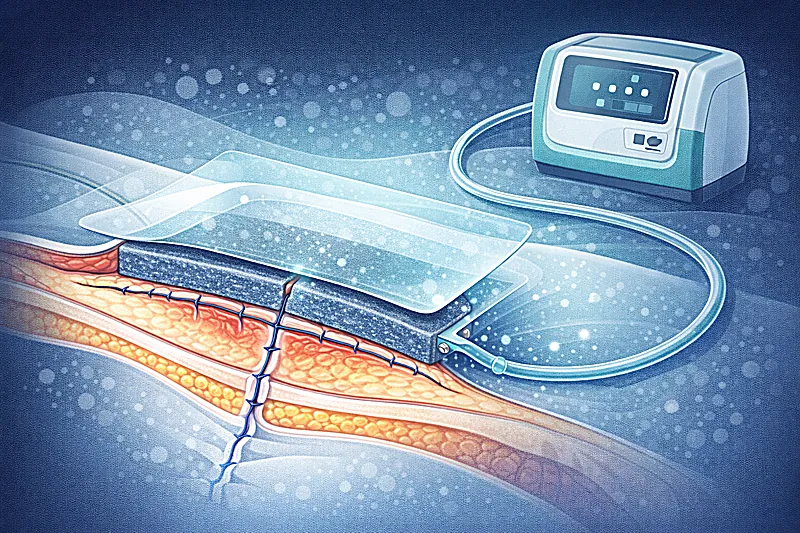
Incisional negative pressure wound therapy (iNPWT) — originally developed for open wound management — has been adapted for use on closed surgical incisions. The proposed mechanisms include reduction of lateral wound tension, removal of exudate and oedema, decreased bacterial contamination, and promotion of local blood flow and lymphatic drainage. However, the evidence has evolved from enthusiastic early case series to a more nuanced picture, where benefit appears concentrated in specific patient populations and wound types. This review synthesises the evidence to answer the clinically critical question: when does iNPWT actually help?
What Evidence Was Reviewed
This synthesis draws on the largest and most recent meta-analyses, specialty-specific systematic reviews, and landmark RCTs comparing incisional NPWT with standard postoperative dressings on closed surgical wounds. The primary outcome across studies was SSI incidence, with secondary outcomes including seroma, dehiscence, reoperation, and readmission. Studies were included across all wound classifications (clean, clean-contaminated, contaminated).
| Study | Design | n | Population | Key Finding | Quality |
|---|---|---|---|---|---|
| de Smet et al. 2023 (eClinicalMedicine) | SR/MA + TSA of 57 RCTs | 13,744 | All surgical specialties | SSI: RR 0.67 (95% CI 0.59–0.76); TSA boundary crossed; GRADE: high | High |
| Sahebally et al. 2018 (JAMA Surgery) | SR/MA | 1,187 | Laparotomy, general/colorectal | SSI reduced; no difference in seroma or dehiscence | Moderate |
| Saunders & Nherera 2022 | Updated SR/MA, 8 RCTs | 1,125 | Vascular groin incisions | SSI: OR 0.39 (95% CI 0.24–0.63) | Moderate |
| Hyldig et al. 2019 (BJOG) | Multicentre RCT | 876 | Obese women, caesarean section | Significant SSI reduction with iNPWT | High |
| Gillespie et al. 2021 (BMJ) | Multicentre RCT | 2,035 | Obese women, caesarean section | No significant SSI reduction with ciNPWT | High |
| CS meta-analysis 2023 (PMC) | SR/MA of RCTs | NR | Obese women, caesarean | SSI: RR 0.79 (0.66–0.95); device type matters | Moderate |
| Stannard et al. 2012 | RCT | 263 | High-risk lower extremity fractures | Significant reduction in deep SSI and dehiscence | Moderate |
| Webster et al. 2019 | SR/MA, orthopaedic trauma | NR | Orthopaedic trauma surgery | Reduced deep SSI, superficial SSI, and dehiscence | Moderate |
| Loubani et al. 2024 | SR/MA | NR | Cardiac surgery (sternotomy) | SSI reduction; device-dependent effects noted | Moderate |
| Horch et al. 2016 | SR/MA, 10 RCTs | 1,089 | Mixed high-risk surgical | SSI: RR 0.54 (0.33–0.89); seroma: RR 0.48 (0.27–0.84) | Moderate |
Key Findings: NPWT on Closed Surgical Incisions by Context
The Overall Evidence: SSI Prevention Is Now Well Established
The most comprehensive meta-analysis to date (de Smet et al. 2023, eClinicalMedicine) pooled 57 RCTs with 13,744 patients across all surgical specialties and wound classifications. Incisional NPWT reduced SSI by 33% compared with standard dressings (RR 0.67, 95% CI 0.59–0.76, I² = 21%). Critically, the trial sequential analysis monitoring boundary for benefit was crossed, indicating that this effect estimate is stable and unlikely to change meaningfully with additional trials. GRADE assessment rated the certainty of evidence as high — a designation achieved by few wound care interventions.
Earlier, more focused meta-analyses showed broadly consistent results but with larger effect sizes, likely reflecting the higher-risk populations studied. Horch et al. (2016, 10 RCTs, 1,089 patients) reported a 46% SSI reduction (RR 0.54, 95% CI 0.33–0.89) and a 52% seroma reduction (RR 0.48, 95% CI 0.27–0.84). The numbers needed to treat varied substantially by context: NNT 3 for seroma prevention, NNT 17 for dehiscence, and NNT 25 for SSI in general surgical populations — dropping considerably in high-risk cohorts.
Where the Evidence Is Strongest: High-Risk Populations
The most consistent benefits emerge in settings where baseline SSI rates are highest. Across the evidence base, three clinical contexts stand out for the strength and consistency of the iNPWT effect: vascular surgery groin incisions, orthopaedic trauma, and high-BMI obstetric patients. In each, the combination of patient risk factors (obesity, diabetes, immunocompromise, contaminated or high-tension wounds) and procedural risk factors (groin location, fracture-related soft tissue damage, emergency surgery) creates a substrate where active wound management confers measurable benefit.
Groin incisions for arterial surgery carry SSI rates of 5–30%, driven by proximity to the perineum, lymphatic disruption, and patient comorbidities (diabetes, peripheral vascular disease, obesity). An updated meta-analysis of 8 RCTs with 1,125 groin incisions found that ciNPWT reduced SSI by 61% (OR 0.39, 95% CI 0.24–0.63). This represents one of the largest and most consistent effect sizes in the iNPWT literature.
However, methodological concerns persist: all 8 RCTs had a high risk of bias for participant blinding (the nature of NPWT devices makes blinding impractical), and no significant differences were found in wound dehiscence, seroma/lymph leak composite, or reoperation rates. The largest multicentre RCT in this space found no benefit, creating tension with the pooled analysis. These discrepancies may reflect heterogeneity in SSI definitions, device types, and application protocols across centres.
Closed fracture fixation — particularly of the distal tibia (pilon fractures), calcaneus, and acetabulum — involves high-energy soft tissue injury that elevates SSI risk well above that of elective orthopaedic procedures. A meta-analysis of studies in orthopaedic trauma found that iNPWT significantly reduced deep SSI, superficial SSI, and wound dehiscence compared with conventional dressings. The landmark Stannard et al. (2012) RCT in 263 patients with high-risk lower extremity fractures demonstrated meaningful reductions in both deep infection and wound breakdown.
An updated 2024 systematic review and meta-analysis of orthopaedic trauma outcomes corroborated these findings but noted high heterogeneity in hospital stay outcomes (I² = 92%), likely reflecting varied institutional discharge practices. Importantly, the benefit appears specific to high-energy trauma; evidence does not support routine iNPWT use after elective total joint arthroplasty in standard-risk patients.
Caesarean delivery accounts for approximately 20–30% of births globally, with SSI rates of 7–10% overall and higher in obese women. The evidence here is instructive for understanding the nuance of iNPWT benefit. The Hyldig et al. (2019) multicentre RCT of 876 obese Danish women found a significant SSI reduction with prophylactic iNPWT. However, the larger Gillespie et al. (2021, BMJ) RCT of 2,035 obese Australian women found no significant reduction — creating apparent contradiction.
A 2023 meta-analysis pooling all caesarean RCTs resolved this by demonstrating overall SSI reduction (RR 0.79, 95% CI 0.66–0.95) but also revealing that the NPWT device type mattered: PICO systems showed a significant benefit (RR 0.72, 95% CI 0.58–0.91) while PREVENA systems did not (RR 0.94, 95% CI 0.68–1.29). This device-specific finding — potentially related to differences in pressure delivery, dressing design, or duration of use — is one of the most clinically actionable insights in the iNPWT literature and may explain discrepancies between individual trials.
SSI after laparotomy is common, with rates of 10–25% in colorectal surgery. The Sahebally et al. (2018, JAMA Surgery) systematic review found that iNPWT on closed laparotomy wounds was associated with reduced SSI rates but similar rates of seroma and wound dehiscence compared with conventional dressings. This pattern — SSI reduction without clear dehiscence benefit — was consistent in the subgroup analysis of the de Smet 2023 meta-analysis for abdominal incisions.
The evidence base for laparotomy is complicated by the mixture of elective and emergency procedures, clean and contaminated wound classes, and the varying use of subcuticular versus stapled closure. Subgroup analyses in the large meta-analysis showed that the SSI reduction held across clean, clean-contaminated, and contaminated wound classifications, suggesting that baseline wound contamination level does not eliminate the benefit — but the absolute risk reduction varies considerably.
Deep sternal wound infection is a devastating complication with mortality rates of 10–25%. The Loubani et al. (2024) systematic review and meta-analysis of iNPWT in cardiac surgery assessed both foam-based (ciNPT-F) and multilayer absorbent (ciNPT-MLA) systems. Both showed trends toward SSI reduction, though the evidence was largely derived from retrospective and prospective comparative studies rather than RCTs. The meta-analysis noted device-dependent effects on outcomes, consistent with the caesarean section data suggesting that iNPWT is not a monolithic intervention — the specific technology matters.
Patients undergoing bilateral internal mammary artery harvest, those with diabetes, and obese patients represent the highest-risk cardiac surgical subgroup for sternal wound complications. The observational evidence for iNPWT in these patients is promising, but adequately powered RCTs with standardised SSI definitions are needed before the intervention can be broadly recommended in cardiac surgery.
Quality and Consistency of Evidence
What the Evidence Does Not Show
No RCT has identified a validated risk threshold below which iNPWT provides no clinically meaningful benefit. Without such a threshold, selective use based on patient risk remains empirical rather than evidence-based. Additionally, blinding is impractical with current iNPWT devices — all major RCTs carry a high risk of performance and detection bias for this reason.
The device-specific findings from the caesarean section literature raise a fundamental question that extends across all surgical specialties: are different iNPWT systems truly interchangeable? The de Smet 2023 meta-analysis did not perform device-level subgroup analysis across all specialties, representing a significant gap. Differences in negative pressure delivery mechanism, dressing interface, and recommended duration of use may produce clinically relevant differences in efficacy.
Formal cost-effectiveness analyses are almost entirely absent from the literature. Given that iNPWT devices cost substantially more than standard dressings, the economic case depends heavily on baseline SSI rates: in low-risk clean surgical wounds (SSI rate 1–2%), the NNT may be unacceptably high for routine use, while in high-risk settings (SSI rate 10–30%), the cost per SSI prevented may be favourable. Additionally, the optimal duration of iNPWT application has not been established — most trials use 5–7 days, but shorter durations have not been adequately tested.
Practical Implications
Based on the current evidence, iNPWT is best understood as a targeted intervention for patients at elevated SSI risk, rather than a universal wound management strategy. The following considerations emerge from the evidence base.
The strongest evidence favours iNPWT for vascular groin incisions, high-energy orthopaedic trauma closures, obese patients undergoing caesarean section, and patients with multiple comorbid risk factors (diabetes, obesity, immunosuppression) undergoing laparotomy. In these groups, the absolute risk reduction is clinically meaningful and may justify the additional cost.
The caesarean section meta-analysis showed a significant SSI reduction with PICO systems but not with PREVENA devices. While this finding requires replication across other surgical contexts, it suggests that clinicians should not treat all iNPWT systems as equivalent. Local device availability, familiarity, and published evidence for the specific device in the intended surgical context should inform selection.
For clean surgical wounds in patients without significant comorbidities (elective hernia repair, laparoscopic cholecystectomy, standard-risk total joint arthroplasty), the absolute risk reduction is likely small relative to the device cost. No evidence currently supports routine iNPWT use in standard-risk populations.
Appropriate antibiotic prophylaxis, glycaemic control, normothermia, skin preparation, and surgical technique remain the foundation of SSI prevention. The evidence supports iNPWT as an additive intervention layered on top of standard care bundles, not as a substitute for them.
Evidence Grade and Bottom Line
Overall Evidence Grade: Strong (SSI reduction) / Limited (optimal patient selection and cost-effectiveness)
The efficacy of iNPWT for SSI prevention is now established with high-certainty evidence across 57 RCTs. However, the evidence for when and in whom to use it — the questions that matter most for clinical decision-making — remains less developed. The benefit-to-cost ratio is highly dependent on baseline SSI risk, which varies by orders of magnitude across surgical contexts.
- Incisional NPWT reduces SSI by approximately one-third across surgical specialties — this finding is confirmed by trial sequential analysis and rated as high-certainty evidence.
- The greatest absolute benefit occurs in high-risk populations: vascular groin wounds, orthopaedic trauma, obese obstetric patients, and patients with multiple SSI risk factors undergoing laparotomy.
- Device type may influence efficacy, as demonstrated in caesarean section data — iNPWT should not be considered a uniform intervention across all commercial systems.
- Evidence does not support routine use in standard-risk clean surgical procedures, and formal cost-effectiveness data are lacking across all indications.
- Blinding remains impractical with current devices, introducing performance and detection bias into all existing RCTs — a methodological limitation that is unlikely to be resolved.
Article Information
For Educational Purposes Only. This is an original evidence synthesis informed by the studies listed below. It does not replace clinical judgement. Drug dosages should be verified against current prescribing information.
References
- de Smet GHJ, Kroese LF, Menon AG, et al. Incisional negative pressure wound therapy for the prevention of surgical site infection: an up-to-date meta-analysis and trial sequential analysis. eClinicalMedicine. 2023;62:102105. DOI: 10.1016/j.eclinm.2023.102105
- Horch RE, Gerber T, Lang W, et al. Meta-analysis of negative-pressure wound therapy for closed surgical incisions. Br J Surg. 2016;103(5):477–486. DOI: 10.1002/bjs.10084
- Sahebally SM, McKevitt K, Stephens I, et al. Negative Pressure Wound Therapy for Closed Laparotomy Incisions in General and Colorectal Surgery: A Systematic Review and Meta-analysis. JAMA Surg. 2018;153(11):e183467. DOI: 10.1001/jamasurg.2018.3467
- Saunders C, Nherera LM. Meta-analysis of prophylactic closed-incision negative pressure wound therapy for vascular surgery groin wounds. J Vasc Surg. 2022;75(5):1743–1752.e5. DOI: 10.1016/j.jvs.2021.11.074
- Henriksen NA, Meyhoff CS, Wetterslev J, et al. Meta-analysis of negative pressure wound therapy of closed groin incisions in arterial surgery. Br J Surg. 2019;106(4):310–318. DOI: 10.1002/bjs.11093
- Hyldig N, Vinter CA, Kruse M, et al. Prophylactic incisional negative pressure wound therapy reduces the risk of surgical site infection after caesarean section in obese women. BJOG. 2019;126(5):628–635. DOI: 10.1111/1471-0528.15413
- Gillespie BM, Webster J, Ellwood D, et al. Closed incision negative pressure wound therapy versus standard dressings in obese women undergoing caesarean section: multicentre parallel group randomised controlled trial. BMJ. 2021;373:n893. DOI: 10.1136/bmj.n893
- Stannard JP, Volgas DA, McGwin G, et al. Incisional negative pressure wound therapy after high-risk lower extremity fractures. J Orthop Trauma. 2012;26(1):37–42. DOI: 10.1097/BOT.0b013e318216b1e5
- Loubani M, et al. Surgical site infection outcomes of two different closed incision negative pressure therapy systems in cardiac surgery: systematic review and meta-analysis. Int Wound J. 2024;21(1):e14599. DOI: 10.1111/iwj.14599
- Strugala V, Martin R. Meta-analysis of prophylactic negative pressure wound therapy for surgical site infections in caesarean section surgery. Surg Infect. 2023;24(7):678–688. DOI: 10.1089/sur.2023.087
- Webster J, Liu Z, Norman G, et al. Negative pressure wound therapy for surgical wounds healing by primary closure. Cochrane Database Syst Rev. 2019;3(3):CD009261. DOI: 10.1002/14651858.CD009261.pub4