
Perioperative GLP-1 Agonists: When to Hold, Continue, or Individualise
How a striking signal for retained gastric content — but not for actual aspiration — reshaped preoperative practice in barely two years
One-Minute Takeaway
- Perioperative GLP-1 agonists slow gastric emptying, and fasted users carry roughly five- to tenfold higher odds of residual gastric content across pooled analyses.
- The largest perioperative synthesis found no associated increase in pulmonary aspiration (OR 1.04, 95% CI 0.87–1.25), and measured aspiration stayed near 0.1–0.2%.
- 2023 ASA guidance advised holding therapy — the day of a daily dose, a week for a weekly dose; 2024–2025 multisociety guidance moved toward continuation with individualised assessment.
- Higher-risk features — dose escalation, high doses, gastrointestinal symptoms, weekly dosing — favour a 24-hour clear-liquid diet, gastric ultrasound, or full-stomach precautions.
- The evidence is largely observational; the optimal hold interval is unresolved, so decisions should weigh aspiration risk against glycaemic control and surgical timing.
Why Perioperative GLP-1 Agonists Matter
Glucagon-like peptide-1 receptor agonists, and the dual GLP-1 and GIP agonist tirzepatide, are now used by millions of patients for type 2 diabetes and obesity. Surgeons increasingly encounter them across the elective operating list.
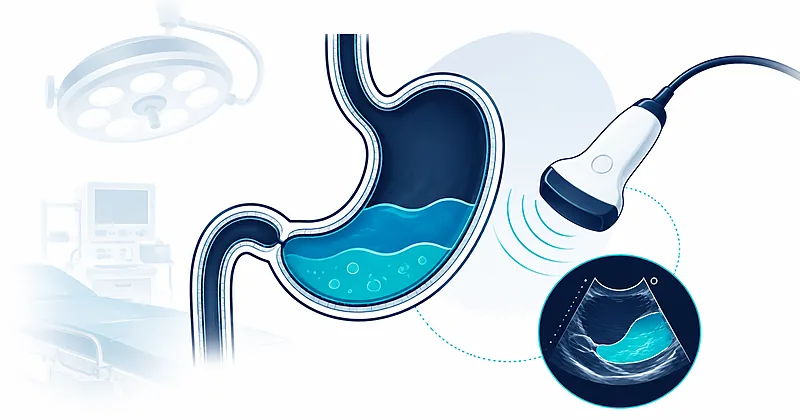
These drugs slow gastric emptying through vagal and central pathways. That mechanism drives their satiety effect — and it raises a distinct perioperative safety question.
If solid food or excess fluid remains in the stomach of a supposedly fasted patient, induction of anaesthesia can permit regurgitation and pulmonary aspiration. Aspiration is an uncommon but serious complication, occasionally fatal, and it sits at the centre of the debate over perioperative GLP-1 agonists.
The tension is genuine. Case reports of aspiration in fasted users prompted a warning added to GLP-1 agonist labels in late 2024, yet the aggregate outcome data are more reassuring than those early reports suggested. Reconciling the two is the practical task facing the perioperative team.
What the Guidance Recommends
The first formal statement came from the American Society of Anesthesiologists in 2023. Its Task Force on Preoperative Fasting reviewed the available literature and acknowledged that evidence was sparse, limited largely to case reports.
On that basis the 2023 ASA guidance suggested holding GLP-1 agonists before elective procedures: for daily formulations, the day of the procedure; for weekly formulations, one week beforehand. The advice applied irrespective of the indication or the type of surgery. Urgent or emergent cases were to be treated as a full stomach and managed accordingly.
Gastroenterology bodies took a more selective line. Later in 2023 the American Gastroenterological Association issued a rapid practice update advocating an individualised approach, proceeding with endoscopy in asymptomatic patients and favouring a clear-liquid diet the day before rather than stopping the drug.
The pivotal shift arrived in October 2024. A multisociety statement led by the ASA, and endorsed by the AGA, the American Society for Metabolic and Bariatric Surgery, the International Society of Perioperative Care of Patients with Obesity, and the Society of American Gastrointestinal and Endoscopic Surgeons, concluded that most patients can continue GLP-1 agonists before elective surgery.
That guidance reserves extra measures for higher-risk patients, who are advised to follow a 24-hour clear-liquid diet before the procedure. It highlights preoperative assessment to identify people at greater risk of delayed gastric emptying, including those in the dose-escalation phase and those on higher doses.
A 2025 multidisciplinary consensus statement from the United Kingdom, spanning anaesthesia, surgery, and diabetes care, reinforced this individualised, continue-where-reasonable framework for GLP-1 agonists, GIP agonists, and SGLT-2 inhibitors together. Across jurisdictions the direction of travel is consistent.
Evidence Reviewed
The comparative table below draws on the studies and pooled analyses that anchor current guidance. It separates the surrogate outcome — residual gastric content — from the clinical outcome that matters most, pulmonary aspiration.
| Study / source | Design | n | Comparison | Key result |
|---|---|---|---|---|
| Elkin 2025 Anaesthesia | Meta-analysis, perioperative (anaesthesia/sedation) | >300,000 | GLP-1 RA vs control | RGC OR 5.96 (3.96–8.98); aspiration OR 1.04 (0.87–1.25), NS |
| Facciorusso 2025 Clin Gastroenterol Hepatol | Meta-analysis, upper endoscopy | 84,065 | GLP-1 RA vs control | RGC OR 5.56 (3.35–9.23); aspiration OR 1.75 (0.64–4.77), NS |
| do Nascimento 2024 Perioper Med | Meta-analysis (RCT + observational), elective surgery/procedures | 2,143 | GLP-1 RA vs control | RGC OR 6.08 (2.86–12.94); GI symptoms OR 7.66 (3.42–17.17); lower glycaemia |
| Sen 2024 JAMA Surg | Cross-sectional, gastric ultrasound | 124 | Once-weekly GLP-1 RA vs control | RGC adjusted prevalence ratio 2.48 (1.23–4.97) |
| Nersessian 2024 Anaesthesia | Prospective, propensity-matched, gastric ultrasound | 220 | Semaglutide (≤10 days) vs control | RGC OR 36.97 (16.54–99.32) |
| Wolla 2025 J Clin Anesth | Prospective cohort, gastric ultrasound (diabetic) | 206 | GLP-1 RA vs control | Full stomach OR 11.3 (5.2–24.7); volume 0.61 vs 0.16 mL/kg |
| Sherwin 2023 Can J Anaesth | Prospective, gastric ultrasound (volunteers) | 20 | Newly-started semaglutide vs control | Solids present RR 7.36 (1.13–47.7) |
The pattern is unusually clear for a topic still described as uncertain. Every study points the same way on residual gastric content, while the two largest pooled analyses find no significant increase in actual aspiration.
Key Changes for Perioperative GLP-1 Agonists
Understanding why guidance moved from “hold everyone” to “continue most” requires separating two questions. Do these drugs leave food in the stomach? And does that translate into harm?
The residual-content signal strengthened
Across ultrasound and endoscopy studies, fasted GLP-1 agonist users consistently show more residual gastric content. Point estimates range widely — from an adjusted prevalence ratio of 2.48 in one cross-sectional study to an odds ratio near 37 in a propensity-matched analysis of recent semaglutide use.
Meta-analyses converge on a pooled odds ratio around five to six. A synthesis of surgical and procedural populations reported residual content odds of 6.08 (95% CI 2.86–12.94), alongside markedly more pre-procedural gastrointestinal symptoms. The surrogate signal is real and reproducible.
The aspiration signal did not follow
Hard aspiration events tell a different story. A 2025 perioperative meta-analysis of more than 300,000 individuals found GLP-1 agonist exposure was not associated with pulmonary aspiration (OR 1.04, 95% CI 0.87–1.25), despite a strong association with residual gastric content.
Endoscopy syntheses agree. In one analysis of 84,065 patients, aspiration odds were not significantly raised (OR 1.75, 95% CI 0.64–4.77). In a dedicated aspiration meta-analysis, events occurred in 0.16% of users and 0.12% of controls — a difference that did not reach significance.
A distended antrum on ultrasound is a marker of risk, not proof of harm. Most patients with residual content do not aspirate, which is why guidance now favours mitigation over blanket cancellation. Reserve holding and rapid-sequence precautions for genuinely high-risk situations.
Blanket holding carries its own costs
Stopping therapy is not free of harm. Interrupting a GLP-1 agonist can worsen glycaemic control, and abrupt cessation adds avoidable case delays and cancellations. For weekly semaglutide the long half-life means a single missed dose changes drug exposure only modestly, so brief holds may achieve little.
These trade-offs help explain the pivot. When the feared outcome is rare and the intervention has downsides, the balance tips toward continuation with targeted precautions rather than universal cessation.
How long to hold remains contested
If holding is deemed necessary, the optimal interval is unsettled. The original ASA position was one dosing cycle for weekly agents. A separate pharmacology review argued for roughly three half-lives — about 20 days for weekly semaglutide — while others favour dose de-escalation.
Emerging data complicate the picture further. In one prospective cohort, gastric volumes were higher when the last dose fell within seven days of surgery, but holding beyond seven days conferred no additional reduction. Whether longer holds add value is not yet resolved.
Quality and Consistency of the Evidence
The certainty attached to each outcome differs sharply, and treating them as equivalent overstates what is known.
- High — residual gastric content is elevated. Strong evidence supports an association between GLP-1 agonist use and increased residual gastric content in fasted patients. The direction is unanimous across cross-sectional, cohort, retrospective endoscopy, and multiple pooled analyses, with pooled odds around five to six.
- Moderate — aspiration is not clearly increased. Evidence suggests no significant rise in actual aspiration, with the two largest syntheses null and absolute rates near 0.1–0.2%. Certainty is tempered because aspiration is rare, leaving analyses underpowered; one large endoscopy synthesis did report a modest significant association.
- Low — optimal hold duration and ultrasound-guided pathways. Insufficient evidence to determine the best hold interval or whether gastric-ultrasound-directed management reduces aspiration. Comparative data are few, and signals on holding beyond seven days conflict.
Several limitations recur. Most studies are observational and vulnerable to confounding by diabetes, body mass index, and coexisting motility disorders. Fasting protocols varied, ultrasound assessment was often unblinded, and heterogeneity was substantial in the residual-content pooling.
What the Evidence Does Not Show
The gaps here are specific, and they matter for how confidently any recommendation can be made.
- No randomised trial compares holding against continuing GLP-1 agonists with aspiration as the endpoint; the question rests on observational data.
- The optimal hold interval is undefined, with competing proposals spanning the day of surgery, one week, and three half-lives.
- Whether ultrasound-guided pathways lower aspiration has not been tested against a clinical outcome.
- Tirzepatide-specific perioperative data are sparse; the drug was excluded from several key studies.
- It is not established that elevated residual content translates into clinically meaningful harm for an individual patient.
- Data in children and in emergency surgery remain limited, so extrapolation from elective adult cohorts is uncertain.
Practical Implications
Framed as what the evidence supports rather than as directives, six considerations follow for the perioperative team.
1. Match the plan to the dosing schedule
Daily and weekly agents behave differently. Because weekly semaglutide has a long half-life, a single skipped dose barely changes exposure, so any decision to hold should account for pharmacokinetics rather than assume a short pause resets risk.
2. Stratify by risk features
Guidance identifies patients at greater risk of delayed gastric emptying: those in dose escalation, on higher doses, on weekly dosing, reporting gastrointestinal symptoms, or with other causes of gastroparesis. Risk assessment, not the drug label alone, should drive the plan.
3. Prefer a clear-liquid diet over routine cessation for most
For most asymptomatic patients, current guidance supports continuing therapy with a 24-hour clear-liquid diet before the procedure. This mitigates residual solids without incurring the glycaemic and scheduling costs of stopping.
4. Use gastric ultrasound when risk is uncertain
Point-of-care gastric ultrasound offers an individualised read on aspiration risk where availability allows. An empty antrum supports proceeding; solid or thick content on scanning warrants reconsideration or added precautions.
5. Apply full-stomach precautions when risk is high or unknown
Where risk is high or gastric status cannot be assessed, treat the patient as a full stomach. Rapid-sequence induction and heightened airway vigilance are reasonable, and urgent or emergent cases should be managed on that footing.
6. Weigh glycaemic and surgical trade-offs, and share the decision
Any hold should be balanced against hyperglycaemia and the disruption of delays or cancellation. Decisions are best made jointly by surgeon, anaesthetist, and patient, and documented, so the rationale is transparent if circumstances change.
Evidence Grade and Bottom Line
Overall grade: Moderate
- Strong, consistent evidence shows fasted GLP-1 agonist users have more residual gastric content, with pooled odds around five to six.
- The evidence does not show a clear increase in actual pulmonary aspiration; the absolute risk stays low, near 0.1–0.2%.
- Guidance has shifted from routine holding in 2023 to continuation with individualised assessment in 2024–2025.
- For most patients a 24-hour clear-liquid diet with standard precautions is reasonable; reserve holding and full-stomach management for higher-risk situations.
- The optimal hold interval and the value of ultrasound-guided pathways remain unresolved and warrant prospective study.
Article Information and References
- Meta-analysisdo Nascimento TS, Pereira ROL, Maia E, Ohnuma T, da Costa MG, Slawka E, et al. The impact of glucagon-like peptide-1 receptor agonists in the patients undergoing anesthesia or sedation: systematic review and meta-analysis. Perioper Med (Lond). 2024;13(1):78. DOI: https://doi.org/10.1186/s13741-024-00439-y
- Meta-analysisFacciorusso A, Ramai D, Dhar J, Samanta J, Chandan S, Gkolfakis P, et al. Effects of glucagon-like peptide-1 receptor agonists on upper gastrointestinal endoscopy: a meta-analysis. Clin Gastroenterol Hepatol. 2025;23(5):715–725.e3. DOI: https://doi.org/10.1016/j.cgh.2024.07.021
- Meta-analysisElkin J, Rele S, Sumithran P, Hii M, Thuraisingam S, Spelman T, et al. Association between glucagon-like peptide-1 receptor agonist use and peri-operative pulmonary aspiration: a systematic review and meta-analysis. Anaesthesia. 2025;80(7):846–858. DOI: https://doi.org/10.1111/anae.16601
- Meta-analysisElmati PR, Kogilathota Jagirdhar GS, Qasba RK, Perez A, Qasba RK, Bains Y, et al. GLP-1 agonists and the risk of pulmonary aspiration during elective upper endoscopy: a systematic review and meta-analysis. Open Respir Med J. 2025;19:e18743064372550. DOI: https://doi.org/10.2174/0118743064372550250603061720
- Cross-sectionalSen S, Potnuru PP, Hernandez N, Goehl C, Praestholm C, Sridhar S, et al. Glucagon-like peptide-1 receptor agonist use and residual gastric content before anesthesia. JAMA Surg. 2024;159(6):660–667. DOI: https://doi.org/10.1001/jamasurg.2024.0111
- CohortNersessian RSF, da Silva LM, Carvalho MAS, Silveira SQ, Abib ACV, Bellicieri FN, et al. Relationship between residual gastric content and peri-operative semaglutide use assessed by gastric ultrasound: a prospective observational study. Anaesthesia. 2024;79(12):1317–1324. DOI: https://doi.org/10.1111/anae.16454
- CohortWolla CD, Pecha TJ, Sirianni JM, Schorg LM, Wolf BJ, Wilson SH. Ultrasound assessment of preoperative gastric volume in fasted diabetic surgical patients: a prospective observational cohort study on the effects of glucagon-like peptide-1 agonists on gastric emptying. J Clin Anesth. 2025;104:111853. DOI: https://doi.org/10.1016/j.jclinane.2025.111853
- CohortSherwin M, Hamburger J, Katz D, DeMaria S. Influence of semaglutide use on the presence of residual gastric solids on gastric ultrasound: a prospective observational study in volunteers without obesity recently started on semaglutide. Can J Anaesth. 2023;70(8):1300–1306. DOI: https://doi.org/10.1007/s12630-023-02549-5
- Case-controlSilveira SQ, da Silva LM, de Campos Vieira Abib A, de Moura DTH, de Moura EGH, Santos LB, et al. Relationship between perioperative semaglutide use and residual gastric content: a retrospective analysis of patients undergoing elective upper endoscopy. J Clin Anesth. 2023;87:111091. DOI: https://doi.org/10.1016/j.jclinane.2023.111091
- CohortAnazco D, Fansa S, Hurtado MD, Camilleri M, Acosta A. Low incidence of pulmonary aspiration during upper endoscopy in patients prescribed a glucagon-like peptide 1 receptor agonist. Clin Gastroenterol Hepatol. 2024;22(6):1333–1335.e2. DOI: https://doi.org/10.1016/j.cgh.2023.11.024
- GuidanceKindel TL, Wang AY, Wadhwa A, Schulman AR, Sharaiha RZ, Kroh M, et al. Multisociety clinical practice guidance for the safe use of glucagon-like peptide-1 receptor agonists in the perioperative period. Surg Obes Relat Dis. 2024;20(12):1183–1186. DOI: https://doi.org/10.1016/j.soard.2024.08.033
- GuidanceHashash JG, Thompson CC, Wang AY. AGA rapid clinical practice update on the management of patients taking GLP-1 receptor agonists prior to endoscopy: communication. Clin Gastroenterol Hepatol. 2024;22(4):705–707. DOI: https://doi.org/10.1016/j.cgh.2023.11.002
- ConsensusEl-Boghdadly K, Dhesi J, Fabb P, Levy N, Lobo DN, McKechnie A, et al. Elective peri-operative management of adults taking glucagon-like peptide-1 receptor agonists, glucose-dependent insulinotropic peptide agonists and sodium-glucose cotransporter-2 inhibitors: a multidisciplinary consensus statement. Anaesthesia. 2025. DOI: https://doi.org/10.1111/anae.16541
- ReviewMilder DA, Milder TY, Liang SS, Kam PCA. Glucagon-like peptide-1 receptor agonists: a narrative review of clinical pharmacology and implications for perioperative practice. Anaesthesia. 2024;79(7):735–747. DOI: https://doi.org/10.1111/anae.16306
- GuidanceJoshi GP, Abdelmalak BB, Weigel WA, Soriano SG, Harbell MW, Kuo CI, et al. American Society of Anesthesiologists consensus-based guidance on preoperative management of patients (adults and children) on glucagon-like peptide-1 (GLP-1) receptor agonists. American Society of Anesthesiologists; 2023. Available at: asahq.org